

Abstract
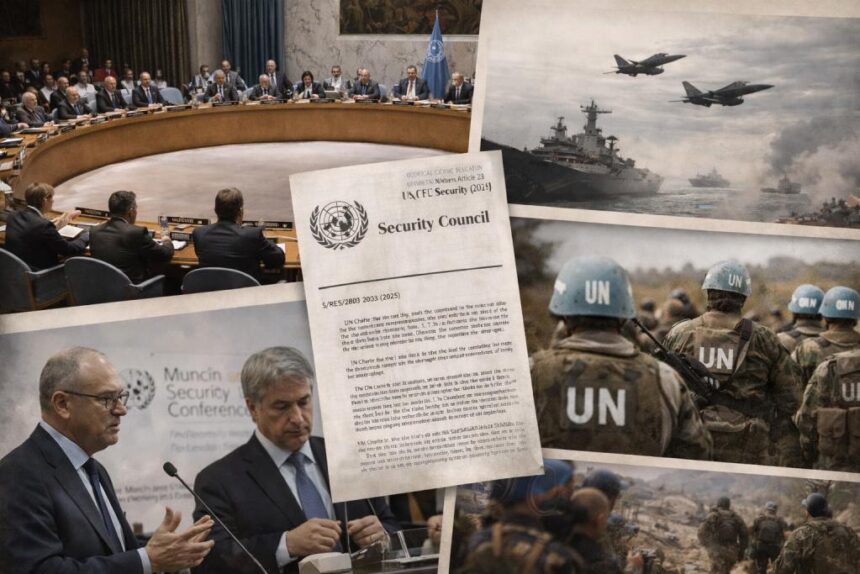
The United Nations Security Council remains the cornerstone of the post-1945 international security architecture, yet persistent structural constraints — most notably the permanent members’ veto — have repeatedly impeded timely collective action. This analysis traces the legal framework governing UN enforcement authority from Articles 39 through 43 and 53 of the UN Charter, examines a representative set of authorised military operations (both successful and catastrophically deficient in mandate or resources), and situates the emergence of Resolution 2803 (2025) and the Board of Peace (BoP) within that longer institutional history. Special attention is given to the 62nd Munich Security Conference (February 2026) as a diagnostic indicator of the current state of multilateral security governance. The article concludes by assessing the BoP’s institutional design — its strengths, vulnerabilities, and potential to complement, rather than supplant, the UN system.
- Article 39: Determination of a Threat
- Article 40: Provisional Measures
- Articles 41 and 42: Non-Military and Military Measures
- Article 43: Special Agreements for the Provision of Forces
- Article 53: Delegation to Regional Organisations
- The Structural Constraint: The P5 Veto
- A. Cases of Effective Authorisation
- B. Cases of Mandate Failure and Institutional Lessons
- C. Cross-Case Analysis
- A. Adoption and Legal Architecture
- B. Core Provisions
- C. Member State Positions
- A. Genesis and Formal Establishment
- B. Executive Board Composition
- C. Institutional Strengths
- D. Institutional Vulnerabilities
- A. The MSC as an Institutional Forum
- B. The 62nd MSC (February 13–15, 2026)
I. The Legal Architecture of UN Enforcement: Charter Articles 39–43 and 53
The United Nations Charter (1945) vests primary responsibility for the maintenance of international peace and security in the Security Council under Article 24. That conferral of authority is operationalised through Chapter VII, whose successive provisions constitute a graduated enforcement ladder, and through the delegation mechanisms of Chapter VIII.
Article 39: Determination of a Threat
Article 39 is the indispensable gateway to Chapter VII action. It empowers the Security Council to determine the existence of any threat to the peace, breach of the peace, or act of aggression, and to decide what measures shall be taken under Articles 41 and 42. The political character of this determination — requiring consensus among the P5 — means that the United Nations Security Council-UN SC action is contingent on geopolitical alignment as much as on legal or factual analysis.
Article 40: Provisional Measures
Before proceeding to enforcement, the UN SC may call upon parties to comply with provisional measures — typically ceasefires, withdrawals, or confidence-building steps. These measures do not prejudge the rights or claims of the parties but are designed to prevent aggravation of the situation. Non-compliance triggers the UN SC’s discretion to escalate toward Articles 41 or 42.
Articles 41 and 42: Non-Military and Military Measures
Article 41 authorises non-military coercive measures — economic sanctions, arms embargoes, severance of diplomatic relations, and communications blockades. When the UN SC determines that such measures would be, or have proved, inadequate, Article 42 authorises it to take military action by air, sea, or land forces as may be necessary to maintain or restore international peace and security. This two-stage design reflects a preference for least-intrusive means, while preserving the ultimate option of collective armed force.
Article 43: Special Agreements for the Provision of Forces
Article 43 was conceived as the linchpin of Charter enforcement. Under Article 43(1), all Member States undertook to make available to the UN SC, on its call and through special agreements, armed forces, assistance, and facilities necessary to maintain international peace and security. Articles 43(2) and (3) required those agreements to specify the numbers, types, degree of readiness, and general location of forces, as well as the nature of assistance and facilities.
In practice, Article 43 was never implemented. Cold War antagonism between the P5 prevented the negotiation of the anticipated standing agreements, and it has remained a dormant provision ever since. In its absence, the UNSC developed the practice of authorising ad hoc coalitions or UN-commanded peacekeeping operations under Chapter VII resolutions — a pragmatic adaptation that traded the Charter’s envisioned reliability for political flexibility.
Article 53: Delegation to Regional Organisations
Article 53, located within Chapter VIII on Regional Arrangements, permits the UNSC to utilise regional organisations for enforcement action — but only with the UNSC authorisation. No enforcement action may be taken under regional arrangements without the UNSC approval. This provision has been invoked to legitimate NATO, African Union, and Economic Community of West African States (ECOWAS) operations, but it simultaneously preserves the UN Security Council’s gatekeeper role and ensures that regional action cannot bypass P5 consent.
The Structural Constraint: The P5 Veto
The procedural architecture of the UNSC grants each of the five permanent members an absolute right of veto over any non-procedural matter under Article 27(3). This mechanism, originally designed as a safeguard to prevent the UN from being weaponised against a great power, has in practice served repeatedly as an instrument for protecting national interests and allied clients at the expense of collective action. The result is a chronic gap between the Charter’s enforcement promise and the UN Security Council’s operational capacity — a gap that has generated recurring demand for institutional alternatives, of which the Board of Peace is the most recent and significant example.
II. UN-Authorised Military Operations: Successes and Instructive Failures
The post-Charter record of UN-authorised military operations is neither uniformly praiseworthy nor uniformly damning. It is, rather, a differentiated record whose outcomes correlate closely with three variables: the clarity and robustness of the mandate; the adequacy of resources, intelligence, and rules of engagement; and the degree of sustained political cohesion among contributing and authorising states. The cases below are selected for their analytical instructiveness rather than their geographical spread.
A. Cases of Effective Authorisation
Korea (1950–1953)
The UN Security Council’s response to the Democratic People’s Republic of Korea’s invasion of the Republic of Korea in June 1950 constitutes the closest historical approximation to the Charter’s enforcement design. With the Soviet Union temporarily absent from the UN Security Council in protest at China’s representation (Republic of China ROC government based in Taipei, which the United States and most Western powers continued to recognize. The Soviet Union insisted that the People’s Republic of China -PRC, established in Beijing in 1949, should rightfully occupy the seat.)
Resolutions 82, 83, and 84 (1950) authorised a United States-led multinational force operating under a unified command to repel the aggression.
The UN Security Council’s response to the outbreak of the Korean War in June 1950 is often cited as the closest historical example of the Charter’s envisioned enforcement system. When North Korean forces crossed the 38th parallel and invaded the Republic of Korea, the UN Security Council acted with unusual speed and clarity.
The coalition’s decisive military response succeeded in restoring the ante bellum border and establishing the principle of collective defence under UN auspices — a precedent of enduring normative importance, even if the particular circumstances (Soviet absence) were unlikely to recur.
Gulf War (1991)
Resolution 678 (1990) authorised Member States cooperating with Kuwait to use all necessary means to secure Iraqi withdrawal. The operation — executed by a broad coalition under American command — achieved its stated military objective within weeks, restoring Kuwaiti sovereignty with a clarity of mandate and sufficiency of resources that stand as a model for Chapter VII enforcement. The political unity among P5 members, enabled by the post-Cold War conjuncture, was as decisive as the military capacity deployed.
Sierra Leone (2000)
The United Nations Mission in Sierra Leone (UNAMSIL) and the parallel British intervention (Operation Palliser) in 2000 demonstrated how a robust mandate combined with timely external military support can rescue a failing peacekeeping operation. Following the Revolutionary United Front’s capture of UNAMSIL personnel and advance on Freetown, British forces intervened, stabilised the situation, and enabled UNAMSIL’s reconfiguration. The eventual disarmament and demobilisation process was substantially completed by 2002, permitting elections the same year — a relatively rare example of mission success in a post-conflict stabilisation environment.
B. Cases of Mandate Failure and Institutional Lessons
Somalia (1993–1994): UNOSOM II
UNOSOM II represented the most ambitious Chapter VII mandate yet attempted in a non-interstate conflict. Resolution 814 (1993) tasked the mission with disarming factions, protecting humanitarian operations, and contributing to political reconciliation — objectives requiring sustained coercive capacity across a fragmented security environment. The operation’s credibility collapsed after the Battle of Mogadishu in October 1993, in which two American Black Hawk helicopters were downed and eighteen US soldiers killed, with Pakistani and Malaysian units playing a critical role in the rescue effort. The subsequent American withdrawal degraded the mission’s deterrent capacity irreparably. Poor coordination between US-led Task Force Ranger and the wider UN command, unrealistic political objectives, and the mission’s failure to distinguish between disarmament and pursuit of a particular faction produced the conditions for strategic overextension. The mission’s termination in 1995 left Somalia without a functional central government for nearly two decades.
Bosnia (1992–1995): UNPROFOR
The United Nations Protection Force in the former Yugoslavia (UNPROFOR) at its peak deployed approximately 38,000 personnel under a mandate that proved fundamentally incoherent: troops were authorised to protect the delivery of humanitarian assistance and to deter attacks on six designated “safe areas,” but were denied the rules of engagement and reinforcements necessary to defend those areas against determined assault. The Srebrenica massacre of July 1995 — in which Bosnian Serb forces commanded by General Ratko Mladić overran the enclave, separated military-age men from their families, and systematically executed approximately eight thousand Bosniaks under the passive observation of lightly armed Dutch peacekeepers — remains the gravest indictment of mandate design in UN history. The episode exposed the lethal consequences of interposing international forces between parties to a conflict without either the will or the means to enforce their protection obligations.
Rwanda (1994): UNAMIR
The United Nations Assistance Mission for Rwanda (UNAMIR) was deployed to monitor implementation of the Arusha Accords — a limited peacekeeping mandate entirely unsuited to the genocidal violence that erupted on 7 April 1994 following the assassination of President Habyarimana. Force Commander Lieutenant-General Roméo Dallaire’s repeated requests to the Department of Peacekeeping Operations for authority to seize arms caches and to protect civilians at risk were denied on mandate grounds. Following the killing of ten Belgian peacekeepers, Belgium withdrew its contingent — the mission’s most capable force element. UNAMIR was reduced to approximately 270 personnel at the moment of maximum killing. Between April and July 1994, an estimated 500,000 to 800,000 persons — predominantly Tutsi and moderate Hutu — were killed. The Rwanda genocide is the definitive illustration of how the combination of an under-resourced mission, a mandate calibrated to political rather than operational reality, and the absence of P5 political will can facilitate atrocity rather than prevent it.
C. Cross-Case Analysis
Across the cases reviewed, three variables consistently distinguish success from failure. First, mandate clarity: operations authorised with unambiguous objectives and commensurate rules of engagement fared markedly better than those in which political compromise produced deliberate ambiguity. Second, resource adequacy: effective operations were staffed, equipped, and funded at levels commensurate with the security environment they were required to manage. Third, political unity: where P5 members maintained cohesive support throughout an operation’s duration, missions could sustain credibility under pressure; where that unity fragmented — as it did after Mogadishu — missions lost their deterrent foundation. These lessons are not merely historical. They constitute the operating parameters against which Resolution 2803 and the Board of Peace must ultimately be assessed.
III. UN SC Resolution 2803 (2025): Legal Basis, Mandate, and Critical Assessment
A. Adoption and Legal Architecture
The UN Security Council Resolution 2803 was adopted on 17 November 2025 at the Council’s 10,046th meeting by a vote of 13 in favour, none against, and two abstentions (China and the Russian Federation). Acting under Chapter VII of the Charter, the UN Security Council endorsed the United States-backed Comprehensive Plan to End the Gaza Conflict, established the Board of Peace (BoP) as a transitional oversight body, and authorised Member States working with the Board to deploy a temporary International Stabilization Force (ISF) in Gaza. The authorization runs until 31 December 2027, subject to the UN Security Council review.
B. Core Provisions
The resolution’s operative architecture rests on four pillars. On humanitarian access, it mandates the full resumption of aid into Gaza, coordinated with the Board and cooperating organisations including the UN, with explicit safeguards against diversion to armed groups. On Israeli military withdrawal, it establishes a framework of agreed standards, milestones, and timeframes under which the Israel Defense Forces will withdraw progressively as the ISF establishes stability, while permitting a security perimeter to remain in place until residual threats subside.
The ISF itself is charged with operating under unified command to secure streets, oversee demilitarization, protect civilians, and escort humanitarian convoys through designated safe corridors. On governance, the resolution authorises the Board and participating states to enter arrangements and create operational entities under the Board’s transitional oversight, with written progress reports to the the UN SC every six months.
C. Member State Positions
The UN Security Council members’ statements at adoption revealed a complex political landscape. The United States framed Resolution 2803 as “a lifeline” for Gaza, emphasising the ISF’s unified command, the framework for phased Israeli withdrawal, and the prospective role of a vetted Palestinian police force in eventual governance. It cautioned that hesitation risked a return to conflict. Algeria, while supporting the ceasefire framework and Palestinian self-determination, described the Force as a “major development” contingent on a trajectory toward full Israeli withdrawal. The United Kingdom and the Republic of Korea noted broad the UNSC support and characterised adoption as a new beginning requiring sustained engagement.
The two abstaining powers registered substantive reservations. China cited vagueness in the provisions governing the Board and Force structure, limited UN participation, and the resolution’s insufficient reference to Palestinian statehood. Among elected members, Slovenia urged clearer terms of reference and greater inclusivity and transparency. Somalia raised concerns about the respective roles assigned to the UN and the Palestinian Authority, and the absence of explicit reference to a two-state solution. These positions — none sufficiently strong to produce a negative vote, but collectively indicating fragile consensus — underscore the resolution’s contested legitimacy and the risk of implementation deficits rooted in political ambiguity.
IV. The Board of Peace: Institutional Design, Capacity, and Limitations
A. Genesis and Formal Establishment
The Board of Peace was initially proposed by the US President Donald Trump in October 2025 in the context of efforts to consolidate the Gaza ceasefire, and received its formal international mandate through Resolution 2803 the following month. Its Charter was signed at the World Economic Forum in Davos on 22 January 2026, with President Trump formally pledging United States leadership and calling for allied financial commitments. The inaugural meeting of the Board took place at the United States Institute of Peace (USIP) in Washington, D.C., on 19 February 2026.
At that meeting, core institutional decisions were confirmed: the Board’s headquarters would be established at USIP, an independent non-profit institute created by Congress in 1984 with a mandate for conflict resolution and prevention; membership would be linked to financial contributions; rules for transparency and reporting were formally adopted; and President Trump was confirmed as inaugural Chair. The meeting was also used to solicit reconstruction pledges, with Trump calling for commitments in the range of $6.5–7 billion for Gaza reconstruction, accompanied by an emphasis on accountability, practical results, and a rotating council of contributors to oversee project implementation.
B. Executive Board Composition
The Executive Board announced at Davos was structured to balance three strategic objectives. Political leadership and diplomatic direction are provided by President Trump as Chair, supported by Secretary of State Marco Rubio, Middle East Envoy Steve Witkoff, and special adviser Jared Kushner. International credibility and governance expertise are contributed by former United Kingdom Prime Minister Tony Blair and World Bank President Ajay Banga. Economic capacity and security perspective are integrated through Apollo Global Management CEO Marc Rowan and National Security Adviser Robert Gabriel.
This composition is notable for its deliberate hybrid character — blending executive political authority, multilateral development institution expertise, and high-capacity private finance. It reflects a design philosophy that treats reconstruction financing as a prerequisite for stabilisation rather than a consequence of it. Whether this philosophy translates into effective governance will depend substantially on how the Board manages the inherent tensions between US leadership, international legitimacy claims, and the interests of contributing states with divergent political priorities.
C. Institutional Strengths
The Board of Peace possesses several structural advantages relative to conventional UN peacekeeping and post-conflict reconstruction mechanisms. Its most significant strength is the potential to bypass the UN SC procedural deadlock: by operating under the terms of an already-adopted resolution and channelling action through an independent body, subsequent operations may proceed without requiring repeated P5 consensus. This could meaningfully accelerate decision-making in time-sensitive stabilisation contexts.
A second strength lies in its direct financing model. By linking membership to financial contributions and integrating private-sector capacity through figures such as Marc Rowan, the Board can potentially mobilise reconstruction capital at a scale and speed that voluntary UN assessed contributions rarely achieve. The historical record of UN reconstruction funding — characterised by pledge-implementation gaps and bureaucratic disbursement cycles — renders this a genuine comparative advantage. A third strength is the Board’s operational focus: its mandate is delimited to the Gaza stabilisation context, enabling institutional design optimised for that specific environment rather than the generalised peacekeeping toolkit.
D. Institutional Vulnerabilities
Against these strengths must be set a set of structural vulnerabilities that could materially compromise the Board’s effectiveness. The most fundamental is the risk of politicisation. An institution whose Chair holds simultaneously the most powerful executive office in the United States and a direct national interest in the outcome of the Gaza process is structurally exposed to the perception — and the reality — of American-directed outcomes. The abstentions of China and Russia at adoption, combined with their reservations about Board governance and UN participation, signal that two permanent members with substantial regional influence regard the BoP as an instrument of US policy rather than a genuinely multilateral body.
A second vulnerability is the membership architecture itself. Tying Board membership to financial contributions is an efficient mechanism for capitalising the operation but a deeply exclusionary one. It structurally marginalises states — including many in the Global South with legitimate interests in Gaza’s political future — that lack the fiscal capacity to contribute at the requisite level. This produces a tension between financial efficiency and political inclusivity that the Board’s current design does not resolve. A third concern, identified by multiple UN SC members at adoption, is mandate vagueness. The resolution’s provisions on BoP governance structure, ISF command arrangements, and the respective roles of the UN, the Palestinian Authority, and contributing states were criticised by China, Slovenia, and Somalia as insufficiently precise. Mandate ambiguity is not merely a drafting inconvenience: as the cases of Somalia, Bosnia, and Rwanda demonstrate, operational imprecision translates directly into accountability deficits and mission vulnerability.
Finally, the Board’s long-term legitimacy faces the challenge of universality. The United Nations Charter derives its authority from near-universal membership and the procedural safeguards it provides. A body whose membership approximates two dozen states, linked by financial contributions and US diplomatic leadership, operates within a significantly narrower legitimacy base — one that may be adequate for the immediate stabilisation task but insufficient for the longer-term political settlement that Gaza ultimately requires.
V. The Munich Security Conference 2026: Institutional Context and Diagnostic Significance
A. The MSC as an Institutional Forum
The Munich Security Conference, founded in 1963 as a transatlantic forum for defence and security policy, has over six decades evolved into one of the most important venues for dialogue among heads of state, ministers, military commanders, and leading security analysts. Its mandate is to strengthen international cooperation and address pressing global security challenges. It commands unparalleled convening authority — but it remains, institutionally, a forum for deliberation rather than decision-making. It produces no binding resolutions, commands no forces, and controls no budgets. Its influence operates through norm-shaping, coalition-building, and the acceleration of political processes that must ultimately be formalised elsewhere.
B. The 62nd MSC (February 13–15, 2026)
The 62nd Munich Security Conference convened against a backdrop of acute systemic stress: the ongoing war in Ukraine, Gaza stabilisation efforts under Resolution 2803, persistent questions about NATO cohesion and burden-sharing, and broader anxieties about the erosion of the post-1945 rules-based order. German State Chancellor Friedrich Merz’s keynote address crystallised European concerns about strategic autonomy and transatlantic reliability, articulating a doctrine of European self-assertion premised on higher defence expenditure, the reinforcement of Europe’s defence industrial base, and deeper integration among NATO allies. His speech was notable for its explicit acknowledgement that European security can no longer be assumed to rest on US guarantees of indefinite reliability.
For the Board of Peace, the MSC provided both an opportunity and an indicator of constraints. On the one hand, the conference’s convening of senior officials from potential ISF-contributing states and reconstruction financiers created a natural environment for coalition-building around the BoP framework. On the other hand, the conference’s discussions reflected considerable scepticism about the Board’s governance design, the vagueness of its operational mandate, and the relationship between US diplomatic leadership and genuinely multilateral decision-making. The MSC’s value as a diagnostic instrument lies precisely here: it revealed that the diplomatic capital available to sustain the BoP remains significant but conditional.
VI. The Board of Peace and the UN System: Complementarity, Competition, and Conditions for Success
The Board of Peace (BoP) is best understood not as a replacement for the UN Security Council but as a pragmatic instrument designed to function in the space created by the UN Security Council’s procedural constraints. Its mandate derives from UNSC Resolution 2803, yet its operational model emphasizes autonomy, flexible financing, and direct engagement with contributors. This asymmetric relationship — dependent on UN authorization but insulated from veto paralysis — defines its distinctive role in the international security framework.
Three conditions consistently determine the success of international stabilization efforts: clarity of mandate, adequacy of resources, and sustained political unity. Against these criteria, the BoP presents both strengths and vulnerabilities. Its financing model, anchored in contribution-linked membership and private-sector integration, is more resilient than the UN’s traditional assessed-contribution system, which has often underfunded operations. Politically, the BoP must demonstrate inclusivity and transparency to consolidate legitimacy. Most critically, the resolution’s lack of precision on command structures, decision-making procedures, and endpoint conditions risks operational ambiguity — a weakness that has historically undermined missions in complex environments.
The BoP’s trajectory may evolve in two directions. It could become an operational force capable of delivering tangible improvements in civilian security, humanitarian access, and reconstruction. Alternatively, it may develop into a lobbying and norm-shaping body, influencing UN deliberations through the collective weight of its founding members. Either path would mark a significant innovation in collective security, though the former would provide more immediate benefits in Gaza.
VII. Conclusion
The Board of Peace, established under Resolution 2803, represents one of the most notable institutional innovations in international security since the rise of regional peacekeeping mechanisms in the 1990s. It engages directly with the UN Charter’s unrealized enforcement potential while attempting to circumvent the veto dynamics that have long paralyzed the United Nations Security Council. Its hybrid character — combining UN authorization, direct financial mobilization, private-sector integration, and streamlined governance — reflects a pragmatic approach to institution-building.
Success will depend on the same variables that have defined past operations: mandate clarity, resource adequacy, and political cohesion. The BoP already demonstrates strength in financing and flexibility, offering a model that could complement the UN system rather than compete with it. If it delivers measurable progress in Gaza, it may prove that innovative mechanisms can reinforce Charter principles and enhance collective security.
In this sense, the BoP is more than a temporary experiment. It is a test of whether international governance can adapt to contemporary challenges with instruments that are both effective and legitimate. Properly implemented, it could demonstrate that complementary bodies can strengthen the UN system, offering a pathway toward more responsive and credible collective action.
Selected Legal and Policy References
UN Charter (1945), Articles 24, 39–43, 53.
UN Security Council Resolution 678 (1990).
UN Security Council Resolution 814 (1993).
UN Security Council Resolution 2803 (17 November 2025).
UN General Assembly Resolution 2758 (XXVI) (1971) — Representation of China in the United Nations.
Report of the Independent Inquiry into the Actions of the United Nations during the 1994 Genocide in Rwanda (S/1999/1257).
Report of the Secretary-General pursuant to General Assembly Resolution 53/35: The Fall of Srebrenica (A/54/549, 1999).
Munich Security Conference, Report 2026 (MSC, February 2026).
Board of Peace Charter (Davos, 22 January 2026).
Dallaire, R. (2003). Shake Hands with the Devil: The Failure of Humanity in Rwanda. Random House.