Mine Action and the Foundations of Recovery

Emil M. Hasanov
Chairman (Founder)
Emil M. Hasanov is a distinguished expert in international security and post‑conflict recovery, with more than two decades of leadership across the United Nations, U.S. Department...
- Chairman (Founder)
2 Min Read

Reflections from the 4th International Mine Action Conference in Baku

A discussion at the 4th International Mine Action Conference in Baku on protecting communities, rebuilding lives and directing innovation towards humanitarian needs.

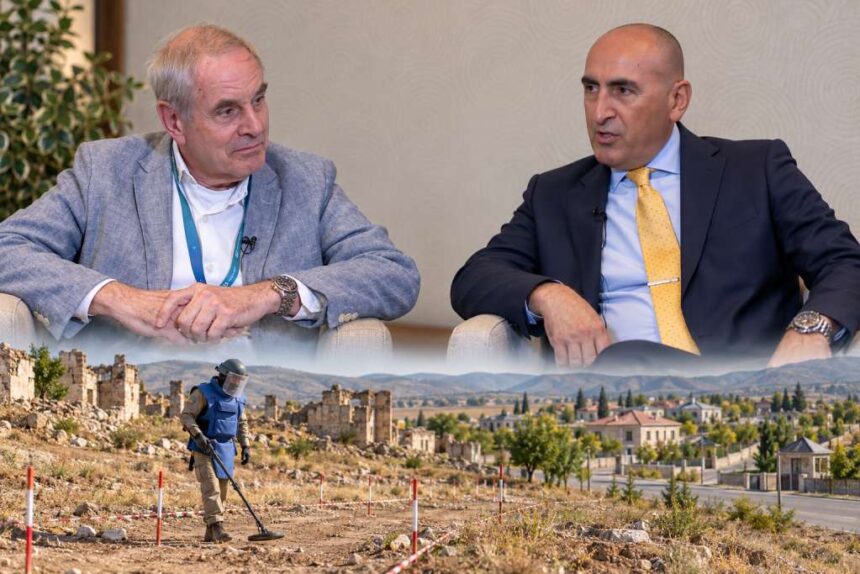
At the 4th International Mine Action Conference, organized by ANAMA and the United Nations in Baku, I had the opportunity to speak with Nigel Ellway, Parliamentary Special Advisor on the Impact of Explosive Weapons at the UK Parliament. Our conversation explored a critical question: how can mine action contribute not only to saving lives, but also to enabling recovery, reconstruction, and the safe return of communities affected by conflict?

In this podcast, we discuss the lasting humanitarian impact of landmines and explosive remnants of war, the importance of integrating mine action into recovery planning from the outset, and how innovation can be directed toward the needs of survivors and vulnerable populations. The discussion highlights why humanitarian demining remains a fundamental pillar of post-conflict recovery and sustainable development.

Acknowledgment and media credit

Video credit: ANAMA — Mine Action Agency of the Republic of Azerbaijan. The original recording is embedded from ANAMA’s YouTube publication. Ownership of the video remains with ANAMA and any other respective rights holders. The analysis and recommendations in this article are the author’s own and should not be read as an official position or endorsement by ANAMA, the United Nations, the UK Parliament or Nigel Ellway.

ANAMA’s official website and social channels

Primary sources

  1. ANAMA, “Nigel Ellway on mine action and the significance of the 4th International Mine Action Conference”, original interview with Emil M. Hasanov.
  2. ANAMA, official announcement of the 4th International Mine Action Conference.
  3. ANAMA, official report on the conference opening, 2 September 2026.

Share This Article
Chairman (Founder)
Follow:
Emil M. Hasanov is a distinguished expert in international security and post‑conflict recovery, with more than two decades of leadership across the United Nations, U.S. Department of State programs, OSCE, EU, and other global institutions. He has served as a strategic adviser to UN peacekeeping in Darfur, Sudan, and directed stabilization initiatives funded by the U.S. Department of State. His fieldwork spans Yemen, Iran, Bosnia and Herzegovina, Ukraine, Georgia, and operations along the Afghanistan and Syrian borders, where he led missions on disarmament, conventional weapons management, and post‑war recovery. Mr. Hasanov’s academic foundation combines law studies at the University of Geneva and Baku State University (LL.M) with advanced training at leading institutions including Cranfield Defense Academy (UK), Carleton University (Canada), George Washington University (USA), Thunderbird School of Global Management, and SOAS, University of London. His career reflects a unique blend of legal expertise, operational leadership, and external affairs. He has advised on communications and external relations with BP AGT, engaging with diplomatic corps, senior officials, and heads of state. He is also co‑founder of the Club de Genève, a platform fostering dialogue among policymakers and scholars. Beyond policy and operations, Mr. Hasanov has established a strong profile in communications and media, serving as author and anchor of GEOPOLITICS talk shows, publishing widely on international relations, and producing documentaries on conflict and recovery. As Founder and Chairman of the International Center for Transatlantic Studies (ICTS), Mr. Hasanov brings this global expertise to advancing the Center’s mission: strengthening transatlantic cooperation, fostering innovative policy dialogue, and promoting collective security.