

- Abstract
- Introduction
- Historical Parallels in Energy Politics
- The Strait of Hormuz: Historical Background
- Legal Regulations on Passage
- Oil Companies in Iran
- Early Concessions
- Reza Shah Era
- Mossadegh and Nationalization
- Consortium Agreement of 1954
- Role of Companies
- Current Situation (2026)
- Scenario Matrix
- Timeline of Key Turning Points
- Conclusion
- Endnotes
باد آورده را باد میبرد
What the wind brings, the wind will take away
— Iranian proverb
Abstract
This article examines Iran’s current crisis through the lens of historical parallels in energy politics and the enduring significance of the Strait of Hormuz. By tracing developments from the Qajar dynasty to Mossadegh, from the Pahlavi monarchs to the Islamic Republic, it highlights how foreign oil companies shaped Iran’s economy and how control of Hormuz became a geopolitical instrument. The analysis integrates scenario matrices, timelines, and risk tables to provide policymakers with structured tools for decision-making. The central argument is that Iran’s energy politics are inseparable from maritime control and sovereignty, and that today’s disruptions echo patterns established over a century ago.
Introduction
Iran’s present crisis is not a sudden rupture but part of a long continuum where energy politics, maritime chokepoints, and domestic upheavals intersect with global security. The Strait of Hormuz has been central to Iran’s leverage since the Qajar era, while foreign oil companies shaped the country’s economic destiny until nationalization. Today, the echoes of the past remind us that energy is never just about economics—it is about sovereignty, resilience, and power.
Historical Parallels in Energy Politics
The 1973 Oil Shock
Iran, as a major OPEC member, benefited from rising revenues but also became entangled in supply manipulation. Western economies faced inflation and recession, revealing their vulnerability to energy dependency.1
The 1979 Revolution
The overthrow of the Shah disrupted oil flows and created uncertainty in global markets. Western powers faced dilemmas balancing energy security with political values.2
The Iran–Iraq War (1980–1988)
Attacks on oil infrastructure and shipping lanes highlighted how regional conflicts destabilize global supply chains.3
The Sanctions Era
From the 2000s onward, sanctions restricted Iran’s exports, incentivizing alternative partnerships with Asia and Russia. The the Joint Comprehensive Plan of Action
(JCPOA) briefly opened reintegration, but the US withdrawal in 2018 renewed instability.4
The Strait of Hormuz: Historical Background
Qajar Dynasty
In the 19th century, the Qajar dynasty recognized Hormuz’s strategic importance but lacked naval capacity to enforce control. Britain’s dominance in the Gulf limited Iran’s influence, though Hormuz remained symbolically tied to sovereignty.5
Reza Shah Pahlavi (1925–1941)
Reza Shah sought to modernize Iran’s military and maritime presence. Hormuz became a focal point for asserting independence from British dominance. Naval bases and infrastructure projects strengthened Iran’s claim.6
Mohammad Reza Shah (1941–1979)
Under the Shah, Hormuz was integrated into Iran’s broader energy strategy. Oil exports surged, and the strait became a lifeline for Western economies. The Shah’s modernization of the navy reinforced Iran’s ability to monitor passage.7
Mossadegh Era (1951–1953)
Prime Minister Mossadegh’s nationalization of oil heightened tensions with Britain. While Hormuz itself was not closed, the crisis underscored Iran’s potential to disrupt energy flows. Mossadegh’s policies revealed the link between sovereignty, oil, and maritime chokepoints.8
Legal Regulations on Passage
- the United Nations Convention on the Law of the Sea (UNCLOS) Framework: Guarantees transit rights for
international shipping. - Iran’s Practice: Iran asserts authority over its territorial waters, requiring documentation and occasionally imposing restrictions. Current debates in Tehran include formalizing a “toll booth regime” for passage.9
Oil Companies in Iran
Early Concessions
- In 1901, the Qajar dynasty granted William Knox D’Arcy exclusive rights to prospect for oil.
- The 1908 discovery in Masjed Soleiman led to the creation of the Anglo-Persian Oil Company (APOC), later BP.
Reza Shah Era
- APOC (renamed Anglo-Iranian Oil Company) controlled production, refining, and exports.
- Iran’s share of revenues was limited, fueling nationalist resentment.
Mossadegh and Nationalization
- Mossadegh’s 1951 nationalization expelled APOC and foreign companies, creating the National Iranian Oil Company (NIOC).
- The boycott and 1953 coup highlighted the geopolitical stakes of oil control.
Consortium Agreement of 1954
- After Mossadegh’s fall, a consortium of foreign companies returned: BP, Royal Dutch Shell, Standard Oil (Exxon, Mobil, Chevron), Gulf Oil, and French CFP (later Total).
- They managed production and exports, while Iran received royalties and a share of profits.
Role of Companies
- BP/APOC: Established infrastructure and dominated exports until nationalization.
- U.S. Majors: Diversified partnerships, linking Iran to Western markets.
- Shell & CFP: Expanded refining and distribution networks.
- NIOC: Became Iran’s national champion, gradually taking over operations until the 1979 Revolution.
Current Situation (2026)
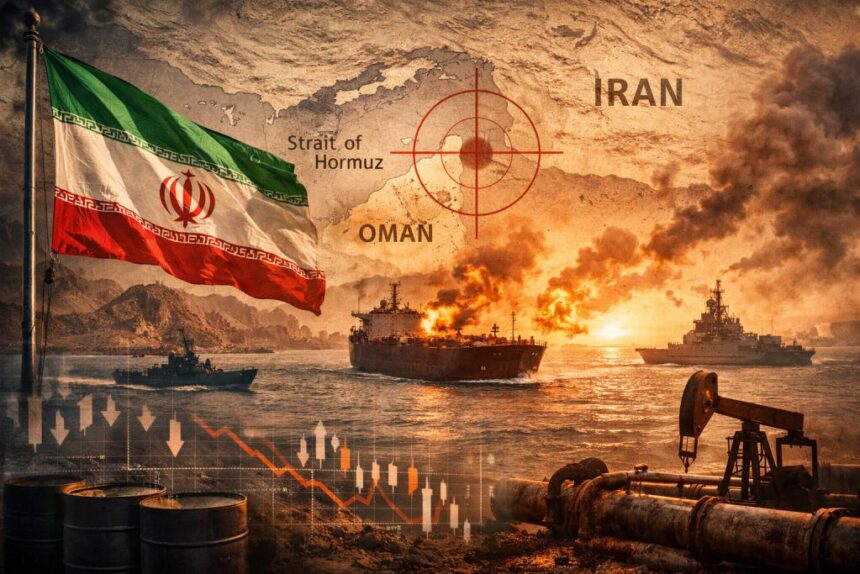
- Following joint US–Israeli strikes, shipping traffic through Hormuz collapsed.
- Iran claims the strait remains open to “non-hostile” vessels, but disruptions have stranded thousands of seafarers.
- Global energy markets face volatility reminiscent of the 1970s oil shocks.10
Scenario Matrix
| Scenario | Energy Policy | Global Impact | Risk Level |
|---|---|---|---|
| Continued Sanctions | Limited exports, reliance on shadow markets | Higher volatility, Asia gains leverage | High |
| Partial Reintegration | Controlled exports under monitoring | Stabilization of markets, cautious investment | Medium |
| Full Reintegration | Open access to global markets | Lower volatility, stronger EU diversification | Low |
Timeline of Key Turning Points
- 1901 – D’Arcy concession, APOC formed
- 1925–1941 – Reza Shah modernizes maritime presence
- 1951–1953 – Mossadegh nationalizes oil, crisis ensues
- 1954 – Consortium Agreement restores foreign companies
- 1973 – Oil Shock reshapes Western economies
- 1979 – Revolution disrupts energy flows
- 1980–88 – Iran–Iraq War targets oil infrastructure
- 2006–2015 – Sanctions intensify, JCPOA signed
- 2018 – US withdrawal from JCPOA renews instability
- 2026 – Current crisis deepens amid sanctions and Hormuz disruptions
Conclusion
From the Qajar dynasty to Mossadegh, from the Shahs to today’s Islamic Republic, Iran’s energy politics and control of the Strait of Hormuz have remained central to its sovereignty and leverage. Foreign oil companies shaped Iran’s economy, but nationalization and subsequent crises revealed the inseparability of oil and politics. Today, Iran continues to use Hormuz as a geopolitical instrument, echoing the past.
Endnotes
- Yergin, Daniel. The Prize: The Epic Quest for Oil, Money, and Power. New York: Free Press, 1991.
- Katouzian, Homa. The Political Economy of Modern Iran. London: Macmillan, 1981.
- Cordesman, Anthony H. The Iran–Iraq War and Western Security. London: IISS, 1987.
- Katzman, Kenneth. Iran Sanctions. Congressional Research Service, updated 2023.
- Floor, Willem. The Persian Gulf: A Political and Economic History of Five Port Cities, 1500–1730. Mage Publishers, 2006.
- Cronin, Stephanie. The Army and the Creation of the Pahlavi State in Iran, 1910–1926. I.B. Tauris, 1997.
- Abrahamian, Ervand. Iran Between Two Revolutions. Princeton University Press, 1982.
- Kinzer, Stephen. All the Shah’s Men: An American Coup and the Roots of Middle East Terror. Wiley, 2003.
- United Nations Convention on the Law of the Sea (UNCLOS), 1982.
- International Crisis Group. Iran and the Strait of Hormuz: Navigating the Current Crisis. Report, 2026.