

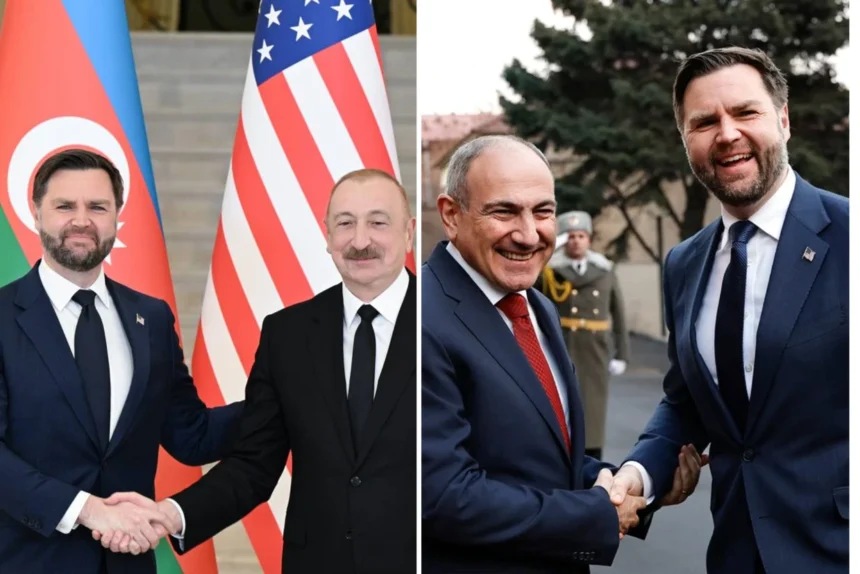
The visit of U.S. Vice President JD Vance to Armenia and Azerbaijan marked a historic moment in South Caucasus diplomacy. Such high-level engagement had not occurred since 2008, when Vice President Dick Cheney visited Azerbaijan and Georgia. Both visits highlight Azerbaijan’s enduring role as the focal point of U.S. regional policy. Its geopolitical position, influence across Central Asia and the Middle East, and extended relations with Europe — including supplying natural gas to eleven NATO member states — make Azerbaijan a reliable partner for Washington.
Washington Summit: Ending a Thirty-Year War
On August 8, 2025, with the initiative and support of U.S. President Donald Trump, Azerbaijani President Ilham Aliyev and Armenian Prime Minister Nikol Pashinyan were invited to Washington, D.C. The summit aimed to bring closure to a thirty-year conflict between the two nations. This breakthrough echoed past U.S. diplomatic achievements, such as the Dayton Agreement of 1995, which ended the war in the former Yugoslavia.
TRIPP Project and the Zangezur Corridor
Vice President Vance also discussed the Trump Regional Infrastructure and Prosperity Project (TRIPP), strongly supported by President Aliyev. Central to this initiative is the Zangezur Corridor, a 42-kilometer route connecting Azerbaijan with the Nakhchivan Autonomous Republic. While strategically vital for Azerbaijan, the corridor is also designed to benefit Armenia by integrating it into a regional framework linking Eurasia with Europe.
Projects of this scale are not only about infrastructure but also about prosperity and peace. Historical examples such as the Panama Canal and the Suez Canal demonstrate how transit routes can generate financial stability and regional growth. In today’s 21st century, with new challenges in logistics and global trade — including disruptions in the Red Sea caused by Houthi activities — the Zangezur Corridor is seen as a stabilizing project that can enhance resilience and economic opportunity.
U.S. Role in Regional Development
Contrary to claims that the United States is newly entering the South Caucasus, Washington has long been a partner in regional projects. The Baku-Tbilisi-Ceyhan oil pipeline and the Southern Gas Corridor are examples of U.S.-Azerbaijan cooperation dating back to the early 1990s. Vance’s visit reaffirmed this legacy and signaled a new era of U.S. engagement in peacebuilding and economic integration.