

BRIEFING NOTE
The Impact of 5G Technology on Financial Markets, Geopolitics, and Power Dynamics
5G technology is not merely an infrastructure that enhances speed and efficiency in financial markets; it has emerged as a strategic instrument that is reshaping global power balances. The acceleration of data flows and the minimization of latency directly influence the competitive capacity of states and institutions across a wide spectrum, from financial transactions to military communication networks. In this context, 5G stands as one of the foundational pillars of what can be described as “data geopolitics,” gradually replacing traditional energy-centric geopolitical frameworks.
Within financial markets, 5G reduces transaction times to the millisecond level, fundamentally transforming market dynamics. This shift significantly advantages high-frequency trading (HFT) actors while establishing a new competitive environment where speed and algorithmic capacity become decisive factors. Superiority in markets is no longer defined solely by access to information, but by the ability to process and act upon that information at unparalleled speed.
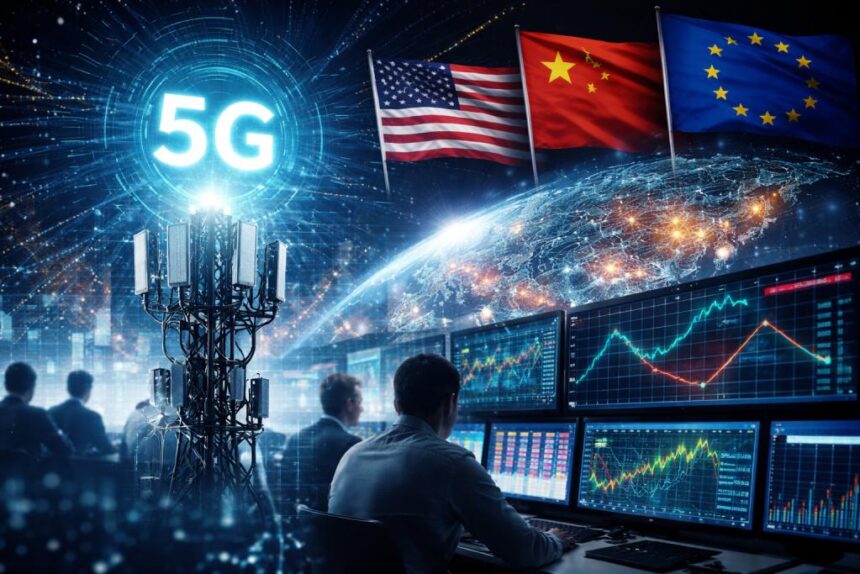
From a geopolitical perspective, 5G infrastructure has become a new frontier of interstate competition. The ongoing technological rivalry between the United States and China is particularly concentrated around 5G infrastructure providers and data security concerns. This competition reflects a multi-layered struggle for power that extends beyond economic dimensions into military and intelligence domains. Control over 5G networks enables influence over data flows and, consequently, decision-making processes, rendering it a critical component of national security.
The European Union, in response to this environment, is pursuing strategic autonomy by strengthening its digital infrastructure, while developing countries face the challenge of balancing technological dependency with data sovereignty. For regional powers such as Turkey, 5G presents both a critical opportunity to enhance economic competitiveness and a significant risk in terms of maintaining digital sovereignty.
The relationship between financial systems and geopolitical power structures becomes increasingly intertwined in the era of 5G. Real-time data flows accelerate global capital movements, while simultaneously introducing new risks such as market manipulation, cyber threats, and algorithm-driven crises. This reality underscores the growing importance of regulation and international cooperation, highlighting that financial stability is no longer purely an economic issue but also a matter of technological security.
In this emerging landscape, the primary strategic priorities for both states and financial actors include the development of low-latency infrastructures, the integration of AI-driven analytical systems, and the strengthening of cybersecurity capabilities. Moreover, data sovereignty, digital independence, and investments in technological infrastructure are becoming integral components of national power projection.
In conclusion, 5G technology represents more than an increase in speed and efficiency within financial markets; it embodies a paradigm shift that redefines global power balances and relocates economic and geopolitical competition onto a data-centric axis. In this new order, the actors who prevail will not only possess financial capital but will also achieve strategic superiority through the effective integration of technology, data, and speed.