

Executive Summary
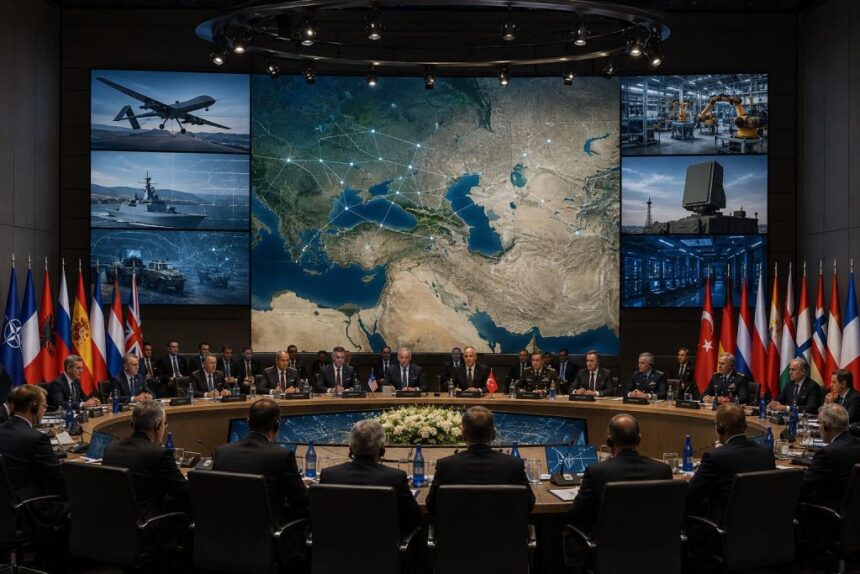
The NATO Summit in Ankara (7–8 July 2026) marked the Alliance’s transition from strategic declarations to implementation. While the 2025 Hague Summit established ambitious commitments on defence spending, resilience, industrial capacity, and support for Ukraine, Ankara focused on assessing progress and creating mechanisms to operationalize those commitments. NATO leaders reaffirmed their “ironclad” commitment to Article 5 collective defence, reviewed progress towards the 5 percent defence and security investment target by 2035, launched new defence-industrial cooperation initiatives, endorsed major capability procurement programs, and strengthened long-term support mechanisms for Ukraine.
- Executive Summary
- Abstract
- Introduction: Why Ankara Matters
- I. Ankara 2026: The Summit of Implementation
- II. From the Hague to Ankara: The Strategic Shift
- III. Türkiye as NATO’s Strategic Centre of Gravity
- IV. Black Sea Security After Ankara
- V. The Organization of Turkic States and Emerging Eurasian Security
- VI. Central Asia’s Growing Strategic Importance
- VII. Middle East Security After the Iran Crisis
- Scenario Analysis: 2026–2035
- Policy Recommendations
- Conclusion
- Selected References
The Ankara Summit demonstrated that NATO increasingly views security through a multidomain lens encompassing conventional deterrence, industrial capacity, emerging technologies, cyber resilience, artificial intelligence (AI), autonomous systems, critical infrastructure protection, and supply-chain security. Allies announced more than EUR 50 billion in capability procurements and agreed to invest over USD 40 billion in counter-drone systems over the next five years.
This paper argues that:
- Ankara represents NATO’s first major implementation summit of the post-Ukraine-war era.
- Türkiye has consolidated its position as one of the Alliance’s indispensable strategic hubs.
- Defence-industrial capacity has become a central pillar of deterrence.
- The Organization of Turkic States (OTS) is gradually emerging as a complementary Eurasian security platform.
- Future Euro-Atlantic security will increasingly rest upon interconnected regional partnerships rather than a single institutional framework.
- NATO’s long-term effectiveness will depend as much on innovation and industrial resilience as on military spending.
Abstract
The 2026 Ankara Summit represents a defining moment in NATO’s ongoing strategic transformation. Unlike the Hague Summit of 2025, which focused primarily on new commitments, Ankara concentrated on implementation, capability development, industrial expansion, and alliance adaptation in an increasingly contested international environment. This article evaluates NATO’s evolution from The Hague to Ankara, analyzes the implications of the summit’s major decisions, examines Türkiye’s expanding geopolitical role, and assesses how emerging regional institutions—particularly the Organization of Turkic States—may contribute to Eurasian stability.
Special attention is given to Black Sea security, the South Caucasus, Central Asia, Ukraine, defence-industrial competition, technological transformation, and the post-Iran crisis security environment.
Introduction: Why Ankara Matters
Throughout its history NATO has undergone several transformational phases:
- Collective Defence during the Cold War (1949–1991)
- Crisis Management after the Cold War (1991–2001)
- Counter-Terrorism and Expeditionary Operations (2001–2014)
- Renewed Deterrence after Crimea (2014–2022)
- Networked Security and Strategic Competition (2022–Present)
The 2026 Ankara Summit may ultimately be remembered as the moment NATO shifted from strategic planning to strategic execution.
Hosted in Türkiye’s capital for the first time, the summit occurred amid:
- The continuing Russia–Ukraine war,
- Deepening technological rivalry among major powers,
- Persistent instability across the Middle East,
- Growing concern over defence-industrial production,
- Intensifying competition over critical infrastructure and supply chains.
NATO leaders gathered not to announce a new strategic concept but to demonstrate that the Alliance could implement the commitments made in The Hague.
I. Ankara 2026: The Summit of Implementation
The Five Major Outcomes
1. Reaffirmation of Collective Defence
Alliance leaders reiterated the centrality of Article 5 and NATO’s 360-degree deterrence posture. The summit declaration emphasized that alliance unity remains the foundation of Euro-Atlantic security.
2. Defence Investment Progress
Ankara reviewed implementation of the 2035 spending commitment adopted in The Hague.
Leaders noted significant progress, with European allies and Canada increasing defence investments substantially since 2025. NATO’s benchmark remains:
- 3.5% of GDP dedicated to core defence spending.
- 1.5% of GDP dedicated to broader security, resilience, innovation and infrastructure protection.
Together these constitute the historic 5% target by 2035.
3. Defence Industry Revolution
A defining feature of Ankara was the growing emphasis on industrial capacity.
Allies agreed to:
- Expand manufacturing capacity,
- Reduce barriers to defence trade,
- Strengthen transatlantic defence-industrial integration,
- Launch the “NATO Front Door for Industry,”
- Deepen cooperation with private-sector innovators.
These decisions recognize that future deterrence depends on production capacity as much as battlefield readiness.
4. Technological Transformation
The summit endorsed major innovation programs, including:
- Artificial Intelligence integration,
- Autonomous systems,
- Counter-drone technologies,
- Precision-strike systems,
- Enhanced intelligence and surveillance capabilities.
More than USD 40 billion was committed to counter-drone capabilities alone.
5. Continued Support for Ukraine
Ukraine remained central to NATO’s strategic calculations.
The Ankara discussions emphasized long-term military assistance, training and capability support, reinforcing the assessment that Ukraine’s security remains linked to broader Euro-Atlantic stability.
II. From the Hague to Ankara: The Strategic Shift
The Hague answered the question:
What should NATO do?
Ankara addressed a different question:
How will NATO do it?
This distinction reflects a broader institutional evolution.
The Alliance increasingly recognizes that military power alone is insufficient. Modern deterrence requires:
- Industrial resilience,
- Technological superiority,
- Supply-chain security,
- Cyber protection,
- Strategic infrastructure defence,
- Civil preparedness.
As a result, NATO is evolving into a comprehensive security ecosystem rather than a purely military alliance.
III. Türkiye as NATO’s Strategic Centre of Gravity
The Ankara Summit also highlighted Türkiye’s growing influence within NATO.
No other ally simultaneously connects:
- Europe,
- The Black Sea,
- The Eastern Mediterranean,
- The Caucasus,
- Central Asia,
- The Middle East.
This geographic position has become increasingly valuable as NATO’s security concerns expand across multiple theatres.
Military Significance
Türkiye maintains NATO’s second-largest armed forces and possesses one of the Alliance’s most rapidly developing defence-industrial sectors.
Systems such as:
- Bayraktar TB2,
- AKINCI,
- KIZILELMA,
have expanded Türkiye’s strategic influence beyond its immediate neighbourhood.
Ankara’s growing indigenous production capability also aligns closely with NATO’s new emphasis on industrial self-sufficiency.
Diplomatic Significance
Türkiye’s ability to maintain engagement with diverse actors—including Ukraine, Russia, Gulf states, Central Asian partners, and NATO allies—provides a diplomatic flexibility increasingly rare in contemporary geopolitics.
For NATO, Türkiye is no longer merely a frontline state; it has become a strategic bridge connecting multiple security regions simultaneously.
IV. Black Sea Security After Ankara
The Black Sea remains NATO’s most critical maritime frontier.
Several factors reinforce its importance:
- The ongoing Ukraine conflict,
- Maritime trade routes,
- Energy transit infrastructure,
- Undersea cable networks,
- Military access between Europe and Eurasia.
Control of the Turkish Straits under the Montreux Convention continues to give Ankara a uniquely influential role in regional security calculations.
Future NATO planning is likely to place greater emphasis on:
- Maritime surveillance,
- Undersea infrastructure protection,
- Unmanned naval systems,
- Regional interoperability.
Türkiye remains indispensable to all four.
V. The Organization of Turkic States and Emerging Eurasian Security
Ankara’s broader geopolitical significance extends beyond NATO.
The emergence of the Organization of Turkic States (OTS) offers new possibilities for regional cooperation.
Although the organization remains primarily economic, cultural and political, several trends support future security coordination:
- Shared strategic geography,
- Expanding connectivity projects,
- Counter-terrorism interests,
- Cybersecurity cooperation,
- Border security coordination.
A Three-Phase Development Model
Phase I (2026–2030)
- Intelligence exchange
- Security dialogue mechanisms
- Joint military education
- Counter-terrorism cooperation
Phase II (2030–2035)
- Logistics coordination
- Crisis-response mechanisms
- Joint training centres
Phase III
- Mature Eurasian security partnership
Importantly, such development should complement NATO rather than compete with it.
VI. Central Asia’s Growing Strategic Importance
Central Asia has become one of the most consequential geopolitical spaces of the coming decade.
The region’s significance derives from:
- Energy resources,
- Strategic transit corridors,
- Critical minerals,
- East-West connectivity projects.
Competition increasingly involves:
- China,
- Russia,
- Türkiye,
- Pakistan
- The European Union,
- Gulf countries.
In this context, the OTS may evolve into a stabilizing framework linking Central Asia more closely to broader Eurasian security networks.
VII. Middle East Security After the Iran Crisis
The confrontation involving Israel, Iran and subsequent American military actions in 2025 demonstrated the fragility of regional security.
Key consequences included:
- Energy market disruptions,
- Maritime security concerns,
- Increased missile and drone proliferation risks,
- Renewed emphasis on deterrence and integrated air defence.
NATO is unlikely to expand directly into Middle Eastern security management, but the Ankara Summit underscored growing awareness that instability south of NATO’s borders increasingly affects European security.
Scenario Analysis: 2026–2035
Scenario 1: NATO Renaissance
Characteristics
- Successful implementation of spending commitments
- Rapid technological innovation
- Strong alliance cohesion
- Effective industrial expansion
Likelihood: Medium–High
Scenario 2: Fragmented Alliance
Characteristics
- Political disagreements
- Uneven burden-sharing
- Divergent threat perceptions
- Institutional friction
Likelihood: Medium
Scenario 3: Networked Security Order
Characteristics
- NATO remains central
- Regional organizations expand
- OTS develops complementary capacity
- Multi-layered partnerships emerge
Likelihood: High
Policy Recommendations
For NATO
- Prioritize implementation over new declarations.
- Accelerate defence-industrial integration.
- Expand AI and cyber governance frameworks.
- Strengthen Black Sea security structures.
- Improve decision-making flexibility during crises.
For Türkiye
- Continue leadership in Black Sea security.
- Expand defence-industrial partnerships.
- Strengthen OTS security coordination.
- Preserve diplomatic mediation capabilities.
- Deepen engagement with Central Asia.
For the European Union
- Reassess long-term strategic engagement with Türkiye.
- Expand practical security cooperation.
- Reduce the disconnect between security cooperation and political dialogue.
- Support connectivity projects linking Europe, the Caucasus and Central Asia.
Conclusion
The 2026 Ankara Summit represents a pivotal moment in NATO’s transformation. If The Hague Summit of 2025 defined the Alliance’s ambitions, Ankara tested its capacity to deliver. NATO leaders reaffirmed collective defence, accelerated defence-industrial cooperation, launched major innovation initiatives, expanded investment in emerging capabilities, and continued long-term support for Ukraine.
For Türkiye, the summit confirmed a broader strategic reality: geography, military capability, defence-industrial development, and diplomatic reach have combined to make Ankara one of the Alliance’s indispensable actors.
Looking ahead, the most probable future is neither a purely Atlantic nor purely regional security system, but a networked order in which NATO remains the central pillar while complementary frameworks—including the Organization of Turkic States—contribute to regional stability across Eurasia.
The central lesson of Ankara is clear: in the twenty-first century, security will be determined not only by armies and alliances, but by innovation, industrial capacity, resilience, connectivity, and the ability to build partnerships across regions once considered strategically separate.
Selected References
¹ Brzezinski, Zbigniew. The Grand Chessboard: American Primacy and Its Geostrategic Imperatives. New York: Basic Books, 1997.
² Freedman, Lawrence. Strategy: A History. Oxford: Oxford University Press, 2013.
³ Kaplan, Robert D. The Revenge of Geography: What the Map Tells Us About Coming Conflicts and the Battle Against Fate. New York: Random House, 2012.
⁴ Mearsheimer, John J. The Tragedy of Great Power Politics. Updated Edition. New York: W.W. Norton, 2014.
⁵ Waltz, Kenneth N. Theory of International Politics. Reading, MA: Addison-Wesley, 1979.
⁶ Kissinger, Henry. World Order. New York: Penguin Press, 2014.
⁷ Huntington, Samuel P. The Clash of Civilizations and the Remaking of World Order. New York: Simon & Schuster, 1996.
⁸ North Atlantic Treaty Organization (NATO). The North Atlantic Treaty. Washington, DC: NATO, April 4, 1949.
⁹ North Atlantic Treaty Organization (NATO). The Alliance’s New Strategic Concept. Rome: NATO, 1991.
¹⁰ North Atlantic Treaty Organization (NATO). The Alliance’s Strategic Concept. Washington, DC: NATO, 1999.
¹¹ North Atlantic Treaty Organization (NATO). Active Engagement, Modern Defence: Strategic Concept for the Defence and Security of the Members of the North Atlantic Treaty Organization. Lisbon: NATO, 2010.
¹² North Atlantic Treaty Organization (NATO). NATO 2022 Strategic Concept. Madrid: NATO, 2022.
¹³ North Atlantic Treaty Organization (NATO). The Hague Summit Declaration. Brussels: NATO, June 25, 2025.
¹⁴ North Atlantic Treaty Organization (NATO). Overview: 2025 NATO Summit in The Hague. Brussels: NATO, 2025.
¹⁵ NATO Parliamentary Assembly. Annual Political and Security Reports. Brussels: NATO Parliamentary Assembly, various years.
¹⁶ International Institute for Strategic Studies (IISS). The Military Balance 2025. London: Routledge, 2025.
¹⁷ Stockholm International Peace Research Institute (SIPRI). SIPRI Yearbook 2025: Armaments, Disarmament and International Security. Oxford: Oxford University Press, 2025.
¹⁸ RAND Corporation. NATO in the Twenty-First Century: Adaptation and Strategic Competition. Santa Monica, CA: RAND Corporation, various publications.
¹⁹ Center for Strategic and International Studies (CSIS). Black Sea Security Reports. Washington, DC: CSIS, various publications.
²⁰ Chatham House (Royal Institute of International Affairs). Turkey’s Foreign Policy and Regional Security. London: Chatham House, various reports.
²¹ Ministry of Foreign Affairs of the Republic of Türkiye. Official Statements and Policy Documents on Regional Security and NATO Affairs. Ankara, 2024–2026.
²² Presidency of the Republic of Türkiye, Directorate of Communications. Türkiye’s Security and Foreign Policy Outlook. Ankara, various publications.
²³ Organization of Turkic States (OTS). Nakhchivan Agreement and Founding Documents. Istanbul: OTS Secretariat.
²⁴ Organization of Turkic States (OTS). Summit Declarations and Strategic Vision Documents. Istanbul: OTS Secretariat, various years.
²⁵ Center for Middle Eastern Studies (ORSAM). Middle East Security Assessments. Ankara: ORSAM, various publications.
²⁶ Center for Strategic Research, Ministry of Foreign Affairs of Türkiye (SAM). Turkish Foreign Policy Papers and Regional Analyses. Ankara: SAM, various publications.
²⁷ Munich Security Conference (MSC). Munich Security Report 2025. Munich: MSC, 2025.
²⁸ European External Action Service (EEAS). EU–Türkiye Relations and Security Cooperation Reports. Brussels: EEAS, various years.
²⁹ United States Congressional Research Service (CRS). NATO and Transatlantic Security: Current Challenges and Policy Issues. Washington, DC: U.S. Congress, 2025.
³⁰ House of Commons Library. Iran, Israel and Regional Security Developments. London: United Kingdom Parliament, 2025.
³¹ European Council on Foreign Relations (ECFR). Europe, NATO and Strategic Autonomy. Brussels: ECFR, various publications.
³² Allison, Graham. Destined for War: Can America and China Escape Thucydides’s Trap? Boston: Houghton Mifflin Harcourt, 2017.
³³ Nye, Joseph S., Jr. The Future of Power. New York: PublicAffairs, 2011.
³⁴ Gray, Colin S. The Strategy Bridge: Theory for Practice. Oxford: Oxford University Press, 2010.
³⁵ Kagan, Robert. The Return of History and the End of Dreams. New York: Alfred A. Knopf, 2008.
³⁶ Fukuyama, Francis. Identity: The Demand for Dignity and the Politics of Resentment. New York: Farrar, Straus and Giroux, 2018.
³⁷ Organization of the Black Sea Economic Cooperation (BSEC). Regional Connectivity and Security Reports. Istanbul: BSEC, various years.
³⁸ United Nations Development Programme (UNDP). Central Asia Regional Risk and Resilience Assessments. New York: UNDP, various publications.
³⁹ World Bank. Central Asia Economic and Security Connectivity Reports. Washington, DC: World Bank, various years.
⁴⁰ Organisation for Economic Co-operation and Development (OECD). Strategic Infrastructure, Resilience and Security in Eurasia. Paris: OECD Publishing, various years.
⁴¹ North Atlantic Treaty Organization (NATO). 2026 Ankara Summit Declaration. Ankara: NATO, July 8, 2026.
⁴² North Atlantic Treaty Organization (NATO). Overview: 2026 NATO Summit in Ankara. Brussels: NATO, July 2026.
⁴³ Daniels, Seamus P. “What Does NATO Defense Spending Look Like Heading into the Ankara Summit?” Center for Strategic and International Studies (CSIS), July 6, 2026.
⁴⁴ Temnycky, Mark. “What Happened at the 2026 NATO Summit in Turkey?” Forbes, July 9, 2026.
⁴⁵ Khan, Sana. “NATO Ankara Summit 2026: Key Issues, Leaders and What to Expect.” Modern Diplomacy, July 6, 2026.