

A Historic Turning Point
For decades, Germany was regarded as an economic powerhouse but a strategically restrained actor in security and defense affairs. The experiences of the First and Second World Wars profoundly shaped German foreign and security policy. Military power was deliberately kept from becoming the central instrument of German statecraft. Instead, the Federal Republic relied on diplomacy, economic interdependence, and deep integration into multilateral institutions such as NATO and the European Union.
- A Historic Turning Point
- From Economic Powerhouse to Military Heavyweight
- A New Balance of Power Within NATO
- Germany’s Geographic Advantage
- The Bundeswehr as the Backbone of European Land Forces
- Air Defense as Germany’s Emerging Strategic Project
- The Growing Importance of the German Navy
- A Leading Conventional Power Without Nuclear Weapons
- What Does This Mean for France and Poland?
- The Limits of Germany’s Military Expansion
- Conclusion
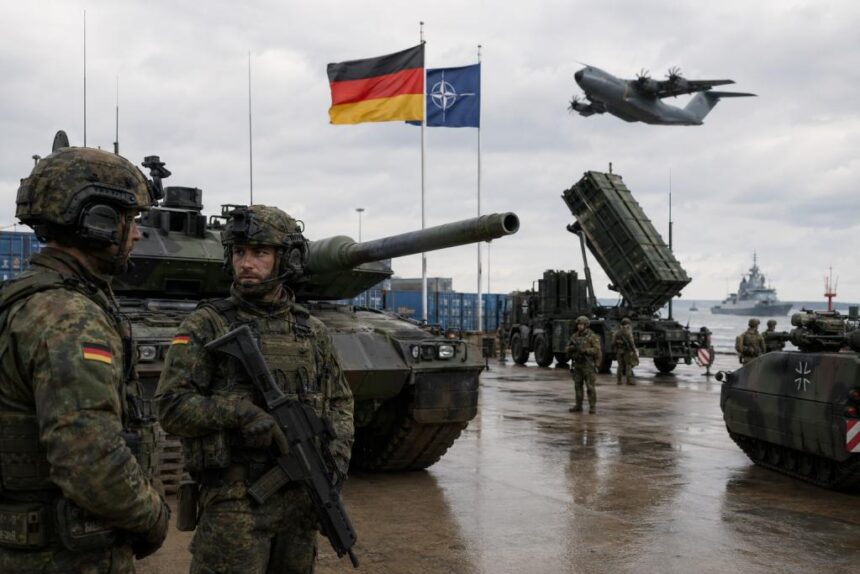
Russia’s full-scale invasion of Ukraine in February 2022 marked a fundamental turning point. Chancellor Olaf Scholz described the moment as a Zeitenwende—a historic shift in Germany’s security policy. The creation of a €100 billion special fund for the Bundeswehr, together with the commitment to sustain significantly higher defense spending, represents the most substantial transformation of German defense policy since reunification.
Germany has since announced its ambition to build the strongest conventional military force in Europe over the coming years. If realized, this transformation will not only reshape the Bundeswehr itself but also alter NATO’s internal military architecture.
From Economic Powerhouse to Military Heavyweight
Germany has long been Europe’s largest economy. Militarily, however, France traditionally occupied the leading position within the European Union, while the United Kingdom maintained the strongest European armed forces within NATO.
Although Germany possessed modern armed forces, decades of underinvestment resulted in equipment shortages, aging infrastructure, and limited operational readiness across many military systems.
The new security strategy focuses on several key objectives:
- Expanding the size of the Bundeswehr.
- Procuring modern air, land, and naval capabilities.
- Improving operational readiness.
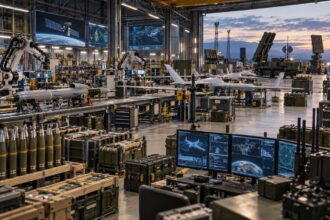
- Strengthening Germany’s defense industrial base.
- Assuming greater leadership responsibilities within NATO.
Should these objectives be achieved, Germany would emerge as one of Europe’s most significant military powers for the first time since 1945.
A New Balance of Power Within NATO
Since its founding, NATO has been overwhelmingly shaped by the United States. While European allies have contributed substantial forces, the majority of the Alliance’s strategic capabilities—including satellite reconnaissance, aerial refueling, missile defense, strategic airlift, and long-range precision strike capabilities—continue to be provided by the United States.
Within Europe, an informal division of responsibilities gradually developed:
- The United States served as NATO’s global military leader.
- The United Kingdom maintained highly capable armed forces alongside an independent nuclear deterrent.
- France combined nuclear capabilities with a long tradition of strategic autonomy.
- Poland has rapidly emerged as a major military power on NATO’s eastern flank since 2022.
- Germany primarily functioned as the Alliance’s logistical and economic backbone.
Germany’s military modernization is beginning to shift this balance.
The country is increasingly evolving into the central conventional military power of Central Europe.
Germany’s Geographic Advantage
Few NATO members possess a geographic position as strategically important as Germany’s.
Located between Western Europe’s major military bases and NATO’s eastern frontline states, Germany serves as the principal transit corridor for allied reinforcements moving toward Poland, Lithuania, and Romania.
This makes Germany increasingly indispensable in several areas:
- Military logistics.
- Strategic stockpiles.
- Ammunition production.
- Maintenance and repair of military equipment.
- Troop movements.
- Air transport.
Much of NATO’s reinforcement planning already depends on German infrastructure.
In the event of a major conflict, Germany would likely become Europe’s primary military logistics hub.
The Bundeswehr as the Backbone of European Land Forces
A central pillar of Germany’s transformation lies in its land forces.
Germany already commands several multinational NATO formations.
These include:
- The permanent deployment of a German brigade in Lithuania.
- Leadership responsibilities for multinational NATO divisions.
- Contributions to NATO’s rapid reaction forces.
As modernization progresses, Germany could provide a substantial share of Europe’s heavy conventional land forces.
Modern main battle tanks, infantry fighting vehicles, artillery, air defense systems, and combat engineering units would position Germany as one of the decisive contributors to the defense of NATO’s eastern flank.
Air Defense as Germany’s Emerging Strategic Project
One of Germany’s most ambitious initiatives is the development of a European integrated air and missile defense network.
Through the European Sky Shield Initiative, Germany seeks to coordinate numerous European nations under a common air and missile defense architecture.
As threats from cruise missiles, ballistic missiles, and drones continue to grow, integrated air defense is becoming one of NATO’s highest priorities.
If fully implemented, Germany could become the organizational center of Europe’s collective air defense system.
The Growing Importance of the German Navy
Historically, Germany’s armed forces have focused primarily on land operations.
However, changing security conditions are also increasing the strategic importance of the German Navy.
The Baltic Sea has become one of NATO’s most strategically significant regions.
With Finland and Sweden joining the Alliance, NATO’s position in Northern Europe has been substantially strengthened.
Germany is expected to play an increasingly important role in:
- Securing maritime supply routes.
- Protecting critical underwater infrastructure.
- Mine countermeasures.
- Anti-submarine warfare.
- Cooperation with the Nordic navies.
This places Germany at the center of NATO’s northern maritime defense posture.
A Leading Conventional Power Without Nuclear Weapons
Despite its military expansion, one crucial distinction remains.
Unlike France and the United Kingdom, Germany does not possess its own nuclear weapons.
Its nuclear protection continues to rely on NATO’s nuclear deterrence, primarily provided by the United States, while Germany participates in NATO’s nuclear sharing arrangements.
As a result, Germany’s future military influence will remain concentrated in the conventional domain.
Combined with its industrial capacity, economic strength, and increasingly modern armed forces, Germany could become Europe’s leading conventional military power.
What Does This Mean for France and Poland?
Germany’s military transformation inevitably affects the balance of power within Europe.
France is expected to retain its position as Europe’s foremost strategic military power due to its independent nuclear deterrent, global military presence, and permanent seat on the United Nations Security Council.
At the same time, Poland continues to invest heavily in its armed forces, particularly in expanding its land forces and strengthening NATO’s eastern defenses.
Rather than creating German military dominance, Europe may increasingly develop a strategic triangle:
- France as Europe’s nuclear and global military power.
- Germany as its industrial and conventional military center.
- Poland as the principal frontline military power on NATO’s eastern border.
Such a distribution of responsibilities could significantly strengthen Europe’s overall defense posture.
The Limits of Germany’s Military Expansion
Whether Germany ultimately achieves its ambitious goals depends on several factors.
The Bundeswehr continues to face significant structural challenges:
- Slow and complex procurement procedures.
- Personnel shortages.
- A shortage of skilled labor.
- Limited production capacity within the defense industry.
- Political changes and long-term budgetary constraints.
German society also remains divided over increased military spending. While many regard stronger armed forces as a necessary response to a deteriorating security environment, others warn against an excessive militarization of foreign policy.
Moreover, military capability alone does not automatically translate into political influence. Lasting strategic leadership requires the effective integration of military power with diplomacy, economic policy, and international cooperation.
Conclusion
Germany is undergoing one of the most profound security policy transformations in its modern history. For the first time since the end of the Second World War, the Federal Republic seeks not only to remain Europe’s economic engine but also to assume substantially greater military responsibility for the continent’s security.
For NATO, this represents a significant shift in the Alliance’s internal structure. Germany is steadily emerging as Europe’s logistical hub, industrial defense center, and potentially its leading conventional military power. France will likely retain its role as Europe’s principal nuclear power, while Poland is expected to remain a key military pillar on NATO’s eastern flank.
At the same time, NATO will continue to depend heavily on the United States for strategic intelligence, global force projection, nuclear deterrence, missile defense, and other high-end military capabilities. Germany’s military expansion is therefore unlikely to replace American leadership. Instead, it is poised to strengthen the European pillar of the Alliance.
Whether Germany ultimately succeeds in establishing a lasting leadership role will depend on sustained political commitment, industrial capacity, and the successful implementation of long-term defense reforms. What already appears clear, however, is that Germany is evolving beyond its traditional role as Europe’s economic anchor and is becoming one of the central actors shaping the continent’s future security architecture.