

Executive Summary
The Strait of Hormuz remains the world’s most strategically significant maritime energy chokepoint. Approximately 17–20 million barrels per day (mb/d) of crude oil and condensate transit through the waterway, representing a substantial share of global seaborne petroleum trade. Any interruption—whether military, political, or economic—would generate severe repercussions for international energy markets, state revenues, shipping insurance costs, inflation levels, and global economic growth.
- Executive Summary
- 1. Introduction
- 2. Global Significance of the Strait of Hormuz
- 3. Chokepoint Geopolitics
- 4. Iraq’s Strategic Vulnerability
- 5. Alternative Export Corridors
- Corridor 1: Kirkuk–Ceyhan
- Corridor 2: Kirkuk–Baniyas
- Corridor 3: Basra–Aqaba
- Corridor 4: Saudi East-West Pipeline
- Corridor 5: UAE Fujairah Pipeline
- 6. Comparative Assessment
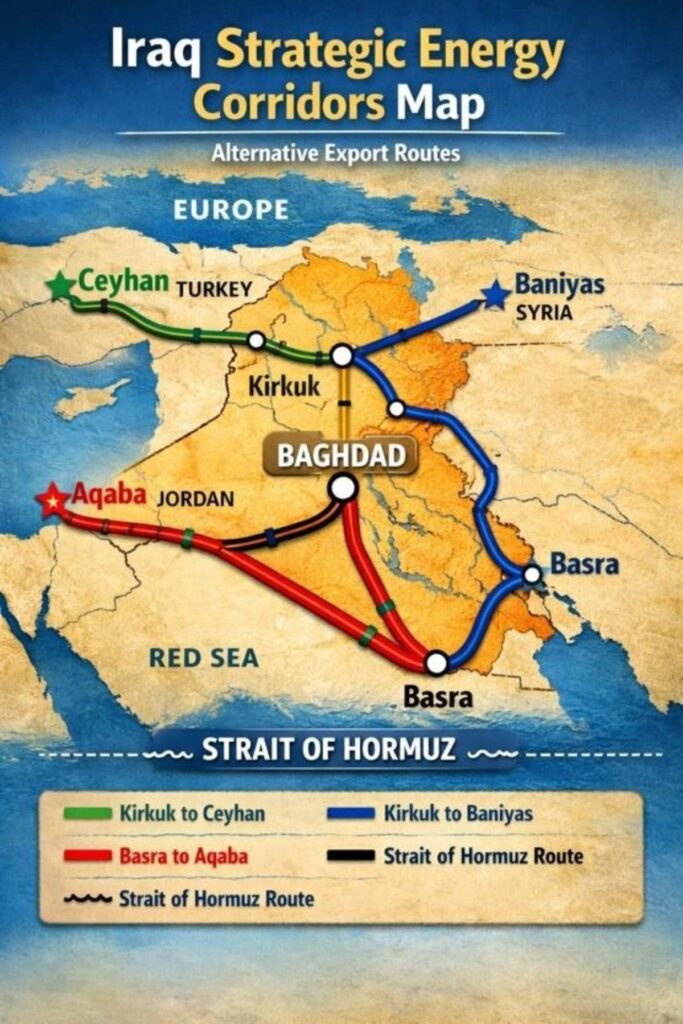
- Strategic Route Map
- Scenario A: Stable Hormuz
- Scenario B: Periodic Disruption
- Scenario C: Extended Closure
- Scenario D: Regional Energy Reconfiguration
- Financial Implications
- Policy Recommendations
- Conclusion
- References
Recent discussions surrounding the revival of the Kirkuk–Baniyas pipeline, alongside renewed proposals for the Basra–Aqaba corridor and expansion of Mediterranean export options, have elevated the strategic importance of overland energy diversification. Iraq, possessing one of the world’s largest hydrocarbon reserves, remains particularly exposed because most of its export infrastructure is concentrated in the south and dependent on Gulf access through Hormuz.
This study argues that:
The objective should not be replacing the Strait of Hormuz, but reducing strategic dependence on it through a resilient multi-corridor export system.
A combination of:
- Kirkuk–Ceyhan (Turkey)
- Kirkuk–Baniyas (Syria)
- Basra–Aqaba (Jordan)
- Strategic storage facilities
- Mediterranean distribution hubs
could substantially enhance Iraqi energy sovereignty and provide greater resilience against geopolitical disruption between 2026 and 2035.
1. Introduction
Energy security has long been recognized as a central pillar of national security. Since the 1973 oil crisis, policymakers have increasingly viewed transport infrastructure as strategically important as hydrocarbon reserves themselves.
The events of 2026 have once again demonstrated the vulnerability of energy flows concentrated through narrow maritime passages. The Strait of Hormuz remains exposed to interstate confrontation, military escalation, sanctions disputes, hybrid warfare, and coercive diplomacy.
For Iraq, whose economy remains heavily dependent on hydrocarbon revenues, diversification of export routes is a strategic necessity rather than an economic preference.
2. Global Significance of the Strait of Hormuz
Physical Characteristics
The Strait of Hormuz connects:
- Persian Gulf
- Gulf of Oman
- Arabian Sea
- Indian Ocean
At its narrowest navigable section, commercial traffic passes through tightly constrained shipping lanes.
Energy Importance
Current estimates indicate:
| Indicator | Estimate |
|---|---|
| Oil Transit | 17–20 mb/d |
| Share of Global Consumption | ~20% |
| LNG Significance | Critical |
| Strategic Importance | Highest Worldwide |
The significance of Hormuz extends beyond oil itself; it affects:
- LNG exports
- Insurance markets
- Freight rates
- Strategic petroleum reserves
- Global inflation
3. Chokepoint Geopolitics
Energy history demonstrates that economic leverage frequently emerges from geographic concentration.
Major chokepoints include:
- Strait of Hormuz
- Bab el-Mandeb
- Suez Canal
- Turkish Straits
- Malacca Strait
Among these, Hormuz remains unique because no existing set of alternatives can fully replicate its throughput. Alternative pipeline systems collectively possess significantly lower theoretical capacity.
4. Iraq’s Strategic Vulnerability
Hydrocarbon Dependence
Iraq remains among the world’s largest oil exporters.
State revenues remain overwhelmingly dependent upon oil.
This creates three national vulnerabilities:
Economic Vulnerability
A disruption in exports immediately affects:
- Government revenue
- Infrastructure investment
- Public salaries
- Budget execution
Geopolitical Vulnerability
External actors acquire leverage over Iraqi economic stability.
Security Vulnerability
Maritime disruption becomes a national security issue.
Analysts increasingly argue that Iraq requires a “second national energy artery” independent of Hormuz.
5. Alternative Export Corridors
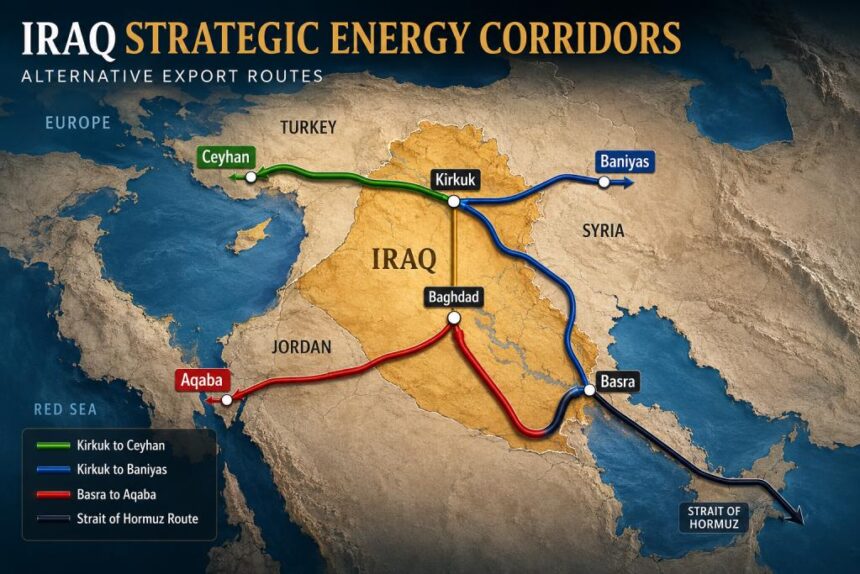
Corridor 1: Kirkuk–Ceyhan
Route
Kirkuk → Turkey → Ceyhan → Mediterranean
Advantages
- Existing infrastructure
- Mediterranean access
- European market integration
- Fastest deployment potential
Weaknesses
- Turkey-Iraq political disputes
- PKK-related security concerns
Corridor 2: Kirkuk–Baniyas
Route
Kirkuk → Syria → Baniyas → Mediterranean
Strategic Value
The route offers:
- Direct non-Hormuz access
- Access to Southern Europe
- Strategic redundancy
The historic line carried approximately 300,000 bpd, while current proposals envision capacities approaching 1.4–1.5 mb/d after reconstruction.
Political Significance
Revival of the corridor could:
- Increase Iraqi autonomy
- Strengthen regional connectivity
- Reduce vulnerability to Gulf disruptions
Corridor 3: Basra–Aqaba
Route
Basra → Jordan → Aqaba → Red Sea
Strategic Importance
Unlike northern corridors, this directly serves southern Iraqi fields.
Potential benefits include:
- Diversification
- Access to Red Sea routes
- Reduced concentration risk
Challenges
- Financing
- Security
- Long-distance infrastructure requirements
Corridor 4: Saudi East-West Pipeline
Route
Eastern Province → Yanbu
Capacity
Approx. 5 mb/d.
Strategic Role
Currently the largest operational alternative to Hormuz.
While primarily serving Saudi exports, it demonstrates the value of strategic infrastructure diversification.
Corridor 5: UAE Fujairah Pipeline
Route
Habshan → Fujairah
Capacity
Approx. 1.5 mb/d
Benefit
Provides direct export capability outside Hormuz.
6. Comparative Assessment
| Corridor | Hormuz Bypass | Capacity Potential | Political Risk | Strategic Value |
|---|---|---|---|---|
| Kirkuk-Ceyhan | Full | High | Medium | Very High |
| Kirkuk-Baniyas | Full | Medium-High | High | Very High |
| Basra-Aqaba | Full | High | Medium | Exceptional |
| Petroline | Full | Very High | Low | High |
| Fujairah | Full | Medium | Low | High |
Strategic Route Map
Scenario A: Stable Hormuz
Probability
Medium
Characteristics
- Limited regional confrontation
- Stable shipping environment
- Lower insurance costs
Implications
Alternative routes remain commercially useful but not essential.
Scenario B: Periodic Disruption
Probability
High
Characteristics
- Temporary closures
- Missile threats
- Insurance spikes
- Naval incidents
Implications
Alternative pipelines become economically attractive.
Most likely future scenario.
Scenario C: Extended Closure
Probability
Low-Medium
Characteristics
- Multi-month disruption
- Severe market shock
- Strategic reserve deployment
Expected Outcomes
Oil prices could experience historic spikes.
Countries with alternative pipelines gain substantial strategic advantage.
Scenario D: Regional Energy Reconfiguration
Probability
Medium
Characteristics
- Mediterranean integration
- Western Iraqi corridors
- Four Seas concept development
Under this scenario, Iraq emerges as a central Eurasian energy transit state.
Financial Implications
Areas of Investment
Infrastructure
- Pipeline construction
- Pumping stations
- Storage terminals
- Digital monitoring systems
Estimated Benefits
- Reduced revenue volatility
- Lower strategic risk premiums
- Improved sovereign credit outlook
- Increased investor confidence
For sovereign wealth funds and development banks, strategic energy infrastructure increasingly serves both commercial and national security purposes.
Policy Recommendations
Immediate (2026–2028)
- Restore Kirkuk–Ceyhan throughput.
- Complete feasibility studies for Kirkuk–Baniyas.
- Accelerate Basra–Aqaba negotiations.
- Expand strategic storage capacity.
Medium-Term (2028–2031)
- Construct western corridor infrastructure.
- Integrate regional electricity and energy networks.
- Create Mediterranean export hubs.
Long-Term (2031–2035)
- Establish multi-corridor export architecture.
- Reduce dependence on any single transit state.
- Position Iraq as a regional energy transit hub.
Conclusion
The central question facing Iraqi and regional policymakers is not whether the Strait of Hormuz can be replaced—it cannot. Hormuz will remain indispensable to global energy markets for the foreseeable future.
The strategic objective should instead be diversification.
A coordinated system composed of:
- Kirkuk–Ceyhan
- Kirkuk–Baniyas
- Basra–Aqaba
- Mediterranean storage hubs
- Red Sea access
would dramatically increase Iraq’s resilience, strengthen energy sovereignty, and reduce exposure to geopolitical coercion associated with concentration of exports through a single maritime chokepoint.
References
- Aziz Ibrahim and Dania Arayssi. “Hormuz Closure Emphasizes Iraq’s Need for a Second Oil Export Route.” Oil & Gas Journal, July 6, 2026.
- Middle East Eye. “Exclusive: Syria, Iraq and US Plan to Unveil Mediterranean Pipeline Deal to Bypass Strait of Hormuz.” July 11, 2026.
- Times Now. “US, Iraq and Syria to Revive Mediterranean Oil Pipeline to Bypass Strait of Hormuz.” July 12, 2026.
- Hormuz Strait Monitor. “Can Pipelines Bypass the Strait of Hormuz?” 2026.
- Straits Energy Research. “Pipelines That Bypass the Strait of Hormuz.” 2026.
- Zaman Alwsl. “Iraqi-Syrian Oil Pipeline: Feasibility Study with Capacity of 1.5 Million Barrels per Day.” March 2026.