

Executive Summary and Introduction
The parliamentary elections held in Bulgaria on April 19, 2026, marked a critical turning point, ending the country’s chronic political fragmentation over the past five years and triggering a system-level restructuring. The election results show that under the leadership of the Progressive Bulgarian movement, which won an absolute majority with approximately 44.6% of the votes, a centralized governance model with high executive capacity and eliminating coalition dependence emerged. While this development means political stability, rapid decision-making and reform implementation capacity for Bulgaria in the short term; in the medium and long term, foreign policy orientation brings with it new strategic uncertainties in the context of harmonization with the European Union and security architecture.
The recent political developments in Romania exhibit a tendency that is the opposite of this picture of stability. The dissolution of the coalition government, the disintegration of parliamentary balances and the interruption of the economic reform process are dragging Romania into a process of increasing governance crisis and institutional fragility. In this context, when Bulgaria and Romania are evaluated together, it is no longer necessary to talk about a homogeneous instability on the eastern line of the European Union, but about an asymmetric and multi-layered system pressure: power consolidation and potential divergence of direction in Bulgaria, while political disintegration and loss of capacity in Romania operate simultaneously.
This dual structure is not only a problem of political harmonization for the European Union; it also produces direct effects in the context of economic coordination, energy security and enlargement strategies. While Bulgaria’s strong executive model may evolve into a more autonomous and bargaining line that may make it difficult to produce common policies within the EU; Political instability in Romania has negative effects on the effective use of EU funds, fiscal discipline and investment environment. This risks weakening institutional resilience and slowing down decision-making processes on the EU’s eastern borders.
However, the most critical dimension of the developments is the strategic impact of these two countries for NATO. Although the strong government model in Bulgaria technically offers faster decision-making and military coordination, the current political line’s adoption of a more cautious and pragmatic approach to the Ukraine war and relations with Russia has the potential to create political alignment gaps in NATO’s deterrence architecture on the Black Sea and Eastern Europe line. On the other hand, the political disintegration in Romania may cause the alliance to produce weaknesses in terms of operational continuity, logistical support and defense planning in the same region. When these two developments are evaluated together, the risk emerging on NATO’s southeastern flank is not one-dimensional; it’s a multi-layered vulnerability that is a combination of simultaneous directional divergence and capacity erosion.
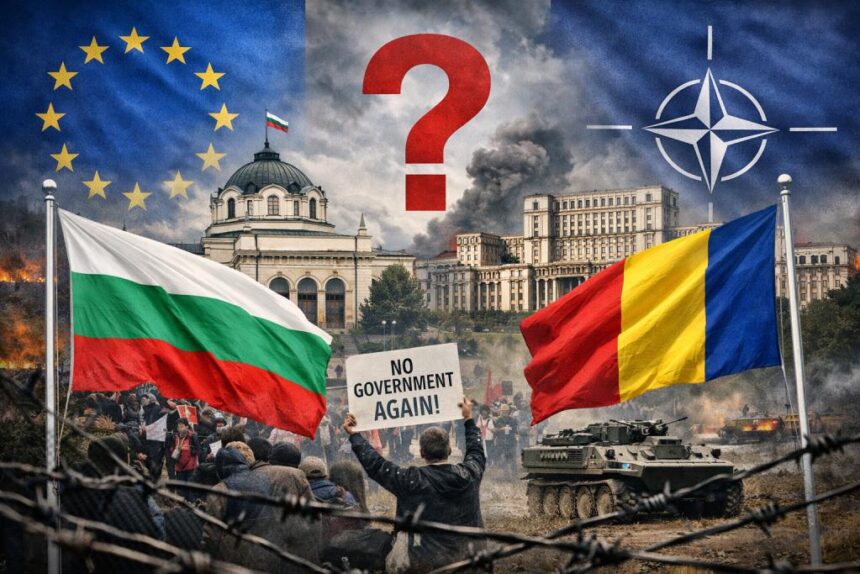
In this context, the current situation goes beyond the problem of weak states in the classical sense and reveals a new paradigm. The main issue on the eastern line of Europe is no longer only the countries with low management capacity; it is also the systemic pressure created by states with strategic orientations that differ while getting stronger and institutional structures that weaken simultaneously. Bulgaria’s strong but potentially autonomous foreign policy line and Romania’s fragile and fragmented governance structure constitute a new testing ground for the regional cohesion of the EU and NATO.
In conclusion, the 2026 elections in Bulgaria and Romania mark the beginning of a new era of geopolitical and institutional balance on the eastern line of Europe. Success in this new era is not only from producing stability; It will be through realigning different national strategies within a common security and policy framework. Otherwise, regional cohesion will be weakened, decision-making processes will be fragmented, and both the integrity of the European Union and NATO’s deterrence will face serious pressures in the medium term.
Election Results: Quantitative Data
| Party | Vote Rate |
|---|---|
| Progressive Bulgaria | %44.6 |
| GERB | %12-16 |
| PP-DB | %12-14 |
| DPS | %6 |
| Party | Vote Rate |
|---|---|
| Ulusal Liberal Parti (PNL) | %27 |
| Social Democratic Party (PSD) | %25 |
| Save Romania Union (USR) | %15 |
| Others | %33 |
According to the election results, the Progressive Bulgarian Party won the first place by far and became the architect of political stability. GERB, PP-DB and DPS parties entered the parliament with relatively low vote percentages. In Romania, on the other hand, the votes were more dispersed, no party could reach the majority to form a government on its own, and the failure of the coalition negotiations deepened the political instability in the country. This picture indicates that a centralized and strong political administration has emerged in Bulgaria, while a fragmented and fragile political structure prevails in Romania.
Strategic and Comparative Analysis
While the strong government model in Bulgaria brings about an acceleration in decision-making processes, it creates new uncertainties in the field of foreign policy. In Romania, the dissolution of the coalition government has created the risk of weakness in administration and inconsistency in foreign policy. The contrasting political developments of these two countries negatively affect the EU’s ability to harmonize and act jointly on the eastern line.
While the new administration of Bulgaria makes it difficult to form a common position within the EU, the instability in Romania deepens the lack of coordination in security and energy policies on the eastern border of the EU. The incompatibility between the two countries, especially in areas such as energy projects and defense cooperation, makes it difficult for the EU to achieve its holistic strategic goals.
In addition, it is foreseen that the new management style in Bulgaria’s relations with NATO may complicate the alliance’s compliance with joint decision-making processes. In Romania, it is expected that the government crisis may lead to delays in cooperation with NATO and regional security weaknesses. In conclusion, the political stability of both countries is vital to ensure cohesion and solidarity on the eastern line of the EU and NATO.
Risk Matrix
| Risk | Probability | Impact |
|---|---|---|
| Weakening of EU harmonization | High | High |
| NATO coordination problem | Medium-High | High |
| Energy delay | High | Medium |
| Political crisis in Romania | High | High |
| Vulnerability on the eastern line | Medium-High | High |
Assessing the risk matrix, the weakening of EU cohesion and coordination problems with NATO are common threats for Bulgaria and Romania. Delays in energy projects can have a moderate impact on both economic and political fields. The political crisis in Romania creates a great fragility in regional security and EU projects. These risks are topics that need to be carefully managed in the future of EU and NATO relations with the new governance structures of both countries.
NATO Perspective
Should NATO and the EU achieve greater integration along the eastern line or develop a new flexible architecture that adapts to diverging national strategies?
From NATO’s perspective, strong government consolidation in Bulgaria could technically facilitate operational coordination within the alliance by increasing decision-making speed in the short term; However, the main determining factor is in which strategic direction this power will be used. The fact that the Rumen Radev line adopts a cautious approach to military support to Ukraine and a more pragmatic approach in relations with Russia has the potential to create “cohesion gaps” in NATO’s deterrence architecture, especially on the Black Sea-Eastern Europe line. This, combined with the political fragility in Romania, creates a risk of simultaneous weakness on the southeastern flank of the alliance: a divergence of political will in Bulgaria and a weakening of capacity in Romania. In conclusion, for NATO, it’s not just about projecting military power; it becomes the maintenance of strategic alignment between members.
Conclusion and Evaluation
The 2026 Bulgarian and Romanian elections have triggered a multi-layered transformation process on the eastern line of Europe, directly affecting not only national political balances but also the strategic architecture of the European Union and NATO. The findings show that the region can no longer be explained with the category of “unstable peripheral countries” in the classical sense; instead, it shows that a new geopolitical phase has been entered where state behaviors evolving in different directions simultaneously produce systemic pressure.
While the strong executive consolidation that emerged in the case of Bulgaria produces political stability and decision-making efficiency in the short term, it reveals that this power should be evaluated together with foreign policy orientation. The strengthening of the central authority may increase the state capacity and pave the way for a more autonomous, bargaining and sometimes divergent policy line within the European Union. This situation creates a potential breaking ground that may cause the erosion of intra-EU cohesion, especially in the context of energy policies, relations with Russia and the Ukraine war.
On the other hand, the political disintegration and the disintegration of the coalition structure observed in Romania is not only an internal political crisis; it also produces a multifaceted vulnerability with economic, institutional and security dimensions. The interruption of reform processes, the weakening of fiscal discipline and the decline in investor confidence limit Romania’s functionality within the European Union and create a significant risk area for NATO’s operational capacity in the region.
The simultaneous occurrence of these two contrasting developments necessitates a new conceptual framework on the eastern line of Europe. The region no longer produces uniform instability; on the contrary, power consolidation and strategic direction divergence on the one hand, and institutional disintegration and capacity erosion on the other, work together. This situation also coincides with the risk matrix revealed in the study; in particular, it strengthens the possibility that high-impact risks such as weakening EU cohesion, NATO coordination problems and regional security gaps will become structural.
From a NATO perspective, while the strong governance structure in Bulgaria theoretically provides a faster decision-making advantage, the potential divergence in strategic alignment could weaken the alliance’s deterrence capacity along the Black Sea and Eastern Europe lines. In Romania, political instability means a direct loss of capacity in terms of military planning, logistical support and operational continuity. When these two dynamics are combined, the risk that arises on NATO’s southeastern flank is not only military; it also deepens on the axis of political harmony and strategic coordination.
In this context, the main conclusion reached is that the problem faced on the eastern line of Europe is no longer only the instability created by weak states; It is the asymmetric system pressure created by states that can change direction while getting stronger and states that are weakening. This new paradigm requires a rethink of both the European Union’s integration capacity and NATO’s deterrence architecture.
The maintenance of regional stability in the coming period depends not only on maintaining stability in Bulgaria or resolving the crisis in Romania. The real decisive factor is that these two different state behaviors can be realigned in a common strategic framework. Otherwise, fragmented decision-making processes, weakening institutional cohesion and increasing geopolitical competition on Europe’s eastern line could turn the region into an area of permanent vulnerability.
In conclusion, the picture that emerged after the 2026 elections serves as a warning for Europe: Stability alone is not enough; The direction, harmony and strategic integration of this stability will be decisive. If this balance is not achieved, both the integrity of the European Union and NATO’s regional effectiveness will face serious challenges in the medium term.