

Abstract
This article explores the dominance of global currencies, focusing on the dollar and the euro, and the absence of viable alternatives outside the West. It examines the failure of BRICS to establish a common currency, Europe’s struggle to sustain the euro amid rising debt and political fragmentation, and the United States’ continued ability to maintain the dollar as the world’s reserve currency. Special attention is given to the debt challenges facing both Europe and the U.S., as well as President Trump’s dual strategy of stabilizing the dollar while promoting cryptocurrencies. Ultimately, the article argues that despite risks and internal challenges, the dollar will remain the world’s indispensable currency, as no credible alternative has yet emerged.
The Global Currency
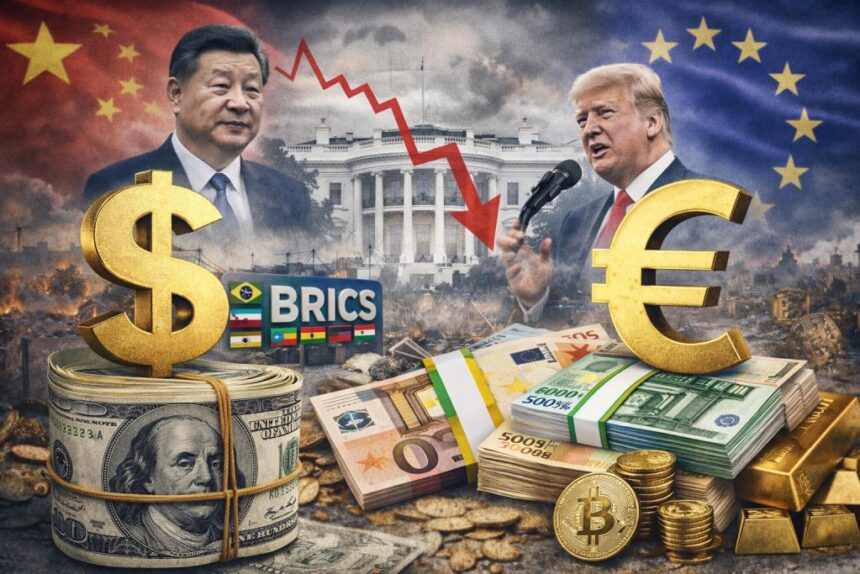
If you look at a world map, you’ll notice two dominant global currencies. Both are Western: the dollar and the euro, with the dollar holding greater significance, not least because the most important commodities are traded in dollars.
No global currency outside the West has yet emerged. Although China is the world’s second‑largest economy, as long as it controls capital flows, does not fully open its markets, and trust in its institutions remains limited, the renminbi – or yuan – lacks the conditions necessary to develop into a global currency.
BRICS is Dead
All attempts to challenge the dollar’s status as the world’s reserve currency have failed. Most recently, BRICS – launched in 2009 by Brazil, Russia, India, China, and South Africa – was intended to lead to a common currency and serve as a counterweight to the dollar’s dominance.
In 2024, the BRICS group expanded to BRICS+ with five new full members: Iran, the United Arab Emirates, Egypt, Ethiopia, and Indonesia. This explosive mix of nations alone shows the project has failed. Ongoing conflicts, particularly involving Iran, have placed members at odds with one another, while others, such as India, never wished to be co‑opted.
This failure illustrates why countries seeking to adopt a common currency face, among many challenges, the primary task of forming a political union as the foundation for joint fiscal policy decisions – and, even more importantly, gaining the confidence of international markets and investors. BRICS may continue to exist in name only; in substance, it is dead.
Europe: The World’s Largest Single Market
With 450 million consumers, Europe is the world’s largest single market. Europeans have realized that a currency without political unity cannot survive in the long term. Since the introduction of the euro in 1999, the European Union has been striving for political unity, a process that has exposed weaknesses in its structure.
Under the pressure of current crises – Russia’s war against Ukraine, Donald Trump’s tariffs, and energy shocks – Europe has begun shifting from ideology‑driven policies to survival‑critical policies based on interests. Although progress is slow compared to global developments, Europe appears ready to face reality.
New candidates such as Iceland and Denmark are now expressing interest in joining the EU. Even if they do not adopt the euro, their membership would stabilize both the Union and the currency.
The greatest threats to the euro lie in debt levels. The Maastricht Treaty of 1992 required member states to keep debt‑to‑GDP ratios at 60%, but this is no longer the case. By 2025, the average stood near 90%, with France and Italy well above 100%. Even Germany, long disciplined in fiscal policy, is now taking on debt to invest in infrastructure and defense, likely reaching a debt‑to‑GDP ratio of 100% by 2050.
The Dollar as the World’s Reserve Currency
Although Europe has created the largest single market, the dollar remains the true global currency. Unlike Europe, the United States does not struggle with political unity in decision‑making. It is the largest national economy and single‑country market, with institutions that enable effective governance.
The dollar is the leading commodity currency and has proven itself as a crisis currency throughout modern history. This resilience is supported by the American “can‑do” attitude – pragmatism, entrepreneurial spirit, enthusiasm for progress, and a hunger for success.
Yet risks remain. U.S. national debt exceeds 120% of GDP, with interest payments surpassing one trillion dollars annually. Total debt now stands at $37 trillion.
The Debt Problem and Trump’s Approach
Global currencies face a debt crisis. While Europe has yet to fully acknowledge it, President Trump is pursuing a two‑pronged approach: strengthening cryptocurrencies (especially stablecoins) as a parallel system, while simultaneously stabilizing the dollar through revenue generation and tough measures.
His clashes with the Federal Reserve stem from the fact that a 1% interest rate hike adds $370 billion in financing costs annually. Trump prefers revenue through economic success rather than tax increases, relying on tariffs, resource acquisition, and privatization to ease the federal budget.
Interventions abroad, such as in Venezuela and Iran, must also be viewed through an economic lens. Meanwhile, U.S. bonds maturing in the coming years require refinancing of $9–11 trillion in debt this year alone – a monumental task requiring market confidence.
Markets remain alert: gold prices have risen by over 100% in three years, while stock markets continue upward despite negative news. Yet the dollar has not lost credibility. The failed BRICS experiment shows that a currency needs more than opposition to the West; it requires political agency, fiscal prudence, economic power, and public belief in success.
The Dollar Will Remain Dominant
Economists often stress market psychology, and currencies rely on it too. The dollar’s advantage lies in its history as a crisis currency, its role as a commodity currency, and the diligence and innovation of the American people.
Only the United States combines economic fundamentals with psychological confidence to sustain a strong currency. Despite challenges, the dollar remains indispensable. The world cannot do without it – simply because there is no alternative.