Following a period in which security could be deferred in the interests of economic efficiency, the world is now confronting the cost of that deferral. Europe’s search for security, US–China rivalry and technological transformation on the battlefield are leading states to seek an answer to the same question: When a crisis begins, do we know not only which weapons we have at our disposal, but also how long we can continue to use them?
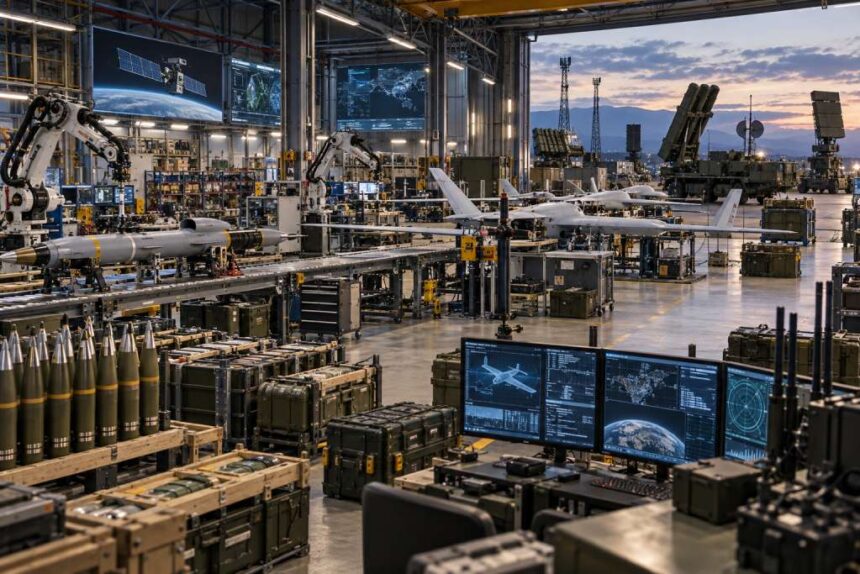
This question will determine the direction of the defence industry in the period ahead. Higher budgets are certainly important. The real change, however, lies in production capacity, technological adaptability, security of supply and industrial policy becoming direct components of deterrence.
According to IISS’s The Military Balance 2026, global defence expenditure reached $2.63 trillion in 2025, with a real increase of 2.5 per cent. The target adopted at NATO’s 2025 Hague Summit envisages allocating at least 3.5 per cent of national income to core defence expenditure and up to 1.5 per cent to defence- and security-related areas by 2035. These are commitments that should not be confused with orders already placed. Nevertheless, the long-term political message to industry is clear: The period of rebuilding security capacity has begun. [1, 2]
Based on these developments, my central forecast is this: Over the next five to ten years, competition in the defence industry will be shaped not only by the ability to develop a superior product, but also by the ability to manufacture it in sufficient numbers, update it using information from the field and keep it operational throughout a crisis.
The production line is part of deterrence. In their study Winning the Industrial War, RUSI researchers Jack Watling and Oleksandr Danylyuk draw attention to Europe’s difficulties in increasing defence production despite the availability of resources. According to their analysis, inadequate industrial mobilisation plans, insufficient knowledge of supply chains and a lack of coordination limited the effectiveness of investment. They specifically note that Russia’s faster growth in production has also entailed significant economic costs. [3]
The implications of this finding for industry are concrete: A country’s security depends not only on the number of platforms in its inventory, but also on ammunition production, maintenance capacity, spare parts stocks and a skilled workforce. I therefore expect multi-year orders, investment in capacity and financing models that sustain critical subcontractors to gain importance. States will have to place a value not only on the product delivered, but also on production capacity that can be rapidly expanded when necessary.
Producing more, however, will not mean manufacturing the same product unchanged for years. In his 2026 Foreign Affairs interview, Michael Kofman explains how superiority in unmanned systems in the war in Ukraine has affected initiative and freedom of action on the ground. At the same time, he emphasises that Russia’s advantages in personnel and materiel did not translate into decisive success during 2025. The lesson to be drawn is that technology delivers results only in conjunction with organisation, training and the way it is employed. [4]
The business models of defence companies may change accordingly. Relationships that end with delivery will give way to long-term partnerships encompassing software updates, mission adaptation, training, maintenance and continuous performance improvement. Customers will ask not only what a system can do today, but also how it will be adapted to a changing threat two years from now.
This transformation is creating a new balance between expensive platforms and low-cost systems. While combat aircraft, submarines and advanced air defence systems will retain their importance, their ability to operate alongside unmanned vehicles that can be produced in greater numbers will become more prominent. The critical measure will be less the technical superiority of an individual vehicle than the cost at which, and the length of time for which, the entire structure can fulfil its mission.
This economic equation may become decisive, particularly in air defence. Continually countering large numbers of low-cost threats with expensive interceptors places pressure on inventories and budgets. I therefore expect demand to increase for layered defence architectures combining electronic jamming, interception systems with different ranges and directed-energy solutions for suitable missions. The requirement here is to be able to select a cost-effective and reliable response appropriate to the threat, rather than providing the same response to every threat.
Jack Watling and Noah Sylvia’s work on electronic warfare complements this point. The researchers note that forces that fail to adapt adequately to electronic warfare may lose their competitive edge against adversaries targeting NATO’s traditional advantages in coordination and precision. [5]
Some of the significant defence investments of the future will therefore remain hidden inside platforms readily visible to the public: secure communications, sensors, electronic protection, mission software and data-processing systems. NATO’s Digital Strategy of January 2026 likewise aims to achieve information and decision superiority through secure, resilient and interoperable digital capabilities. [6]
The impact of artificial intelligence on industry should be assessed within this framework. Its value will emerge from its ability to make sense of large volumes of data, anticipate maintenance needs, organise logistics and reduce the uncertainty facing decision-makers. Nevertheless, reliability, cyber resilience and human oversight must be among the product’s essential characteristics. It should not be forgotten that faster decision-making processes can also accelerate errors.
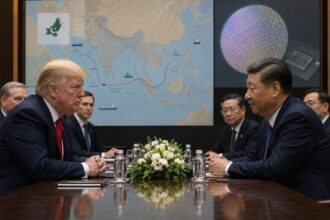
The United States and China, through their rivalry, are two major forces carrying this change beyond regional boundaries.
Meanwhile, it is no longer possible to assume that an innovation in Ukraine affects only Europe’s future. A CSIS study by Lilly Min-Chen Lee and Kateryna Bondar, dated 7 October 2026, finds that, in the examples they examined, Chinese analysts began assessing new battlefield techniques within an average of four months, while translating these into hardware, training and force structure could take a year or longer. [7]
This finding constitutes an important warning about the durability of technological superiority. This is because anticipating how quickly competitors will respond to an innovation is as necessary as developing that innovation. The distance between research, production and field experience in the defence industry will narrow. Successful companies will be those able to turn information from users into new versions without losing it in bureaucratic processes.
Space is another dimension of competition. Disruptions to communications, positioning and reconnaissance services can directly limit the effectiveness of a platform on land or at sea. NATO’s Commercial Space Strategy therefore stands out for its emphasis on the contribution of commercial capacity to the Alliance’s needs and the resilience of space services, offering specialists a comprehensive perspective. [8]
The implications of all this for industry will extend beyond satellite manufacturing. Ground stations, secure terminals, satellite data processing, alternative positioning solutions and communications networks resilient to disruptions may become more important. As cooperation among defence, aviation and space companies deepens, civilian technology companies will also participate more extensively in the defence ecosystem.
Europe’s rearmament brings economic opportunity and political selectivity at the same time. The EU’s SAFE instrument envisages providing member states with up to €150 billion in loans to support joint defence procurement. This amount is neither a directly distributed grant nor a total consisting entirely of confirmed weapons orders; it is a financing facility. [9]
On this basis, I believe that local partnerships, security of supply, maintenance infrastructure and political trust will become more decisive in the European market alongside price and performance. Defence exports will increasingly require industrial diplomacy. In addition to access to a product, purchasing countries will seek assurances that they can use and sustain it during a crisis.
Nevertheless, these trends should not be read as a justification for unlimited armament. In his assessment of Europe’s nuclear deterrence, Lawrence Freedman argues that the deterrent effect needed to prevent the gravest scenarios does not always require fundamental changes to doctrine or force structure. This approach is an important observation pointing to the need to preserve the link between means and political objectives while acknowledging the seriousness of the threat. [10]
Taking a broader view of the issue and drawing on observations from recent conflicts, we can readily say the following: The scale of defence expenditure cannot, on its own, be a measure of strategic success. Resources committed to the wrong capabilities, systems with heavy maintenance requirements and platforms that cannot operate together can reduce the impact of large budgets. The central management question in the period ahead will be which security gap each additional resource spent actually closes.
For Türkiye, I see this picture as an opportunity to deepen capacity. The priority should be to complement the ability to develop platforms with critical components, serial production, ammunition, electronic warfare, software and space services. The sustainability of exports will also depend on post-sale training, maintenance, modernisation and security of supply. When developing joint production models, preserving authority over the design and updating of critical technologies is particularly important.
For this approach to succeed, small and medium-sized technology companies, universities and financing institutions must be aligned with the same objective alongside large companies. Defence industrial policy is as much a matter of human resources and capital allocation as it is of production.
The deterrence of the future will depend as much on the will to renew and sustain military power as on the strength of the weapons at hand. This is the clearest message of the new geopolitics to the defence industry: A country’s strategic weight will be measured, before what it can purchase in a crisis, by what it can produce, what it can keep operational and how quickly it can adapt to change.
Sources
The numbers in the text correspond to the sources below. The strategists’ views have been summarised while preserving their meaning; they are not direct quotations. The forward-looking assessments of industry are the author’s own inferences.
- [1] IISS. The Military Balance 2026 — Global defence spending. 2026. Access source
- [2] NATO. The Hague Summit Declaration. 25 June 2025. Access source
- [3] Oleksandr V Danylyuk and Jack Watling. Winning the Industrial War Comparing Russia Europe and Ukraine 2022–24. RUSI, 2025. Access source
- [4] Michael Kofman. Bonus Podcast Episode Is There an Endgame in Ukraine? Foreign Affairs, 2026. Access source
- [5] Jack Watling and Noah Sylvia. Competitive Electronic Warfare in Modern Land Operations. RUSI, 30 January 2025. Access source
- [6] NATO. Alliance Digital Strategy. 13 January 2026. Access source
- [7] Lilly Min-Chen Lee and Kateryna Bondar. Learning Without Bleeding China’s Lessons from the Russia-Ukraine Drone War. CSIS, 7 October 2026. Access source
- [8] NATO. NATO Commercial Space Strategy. 13 February 2025. Access source
- [9] Council of the European Union. What is Security Action for Europe SAFE? Access source
- [10] Lawrence Freedman. Europe’s Nuclear Deterrent The Here and Now. IISS, June 2025. Access source