
Abstract
This article examines the transformation of the Houthi movement (Ansar Allah) from a localized Zaydi revivalist organization in northern Yemen into a strategically significant non-state military actor with regional and global implications. The study analyzes the movement’s origins, ideological evolution, military development, and integration into Iran’s broader network of allied armed groups known as the “Axis of Resistance.” Particular attention is given to the geopolitical and economic consequences of Houthi operations against maritime commerce in the Red Sea and Bab el-Mandeb Strait between 2023 and 2025.
- Abstract
- Introduction
- Historical Origins and Ideological Foundations
- Iran’s Proxy Strategy and Support Network
- 1. Counterbalancing Saudi Arabia
- 2. Strategic Access to Maritime Chokepoints
- 3. Deterrence Through Proxy Warfare
- The Houthi Seizure of Sana’a and Consolidation of Power
- Military Evolution: Missiles, Drones, and Strategic Reach
- The Red Sea Crisis and Global Trade Disruption
- Strategic Importance of the Red Sea
- Economic Cost of Houthi Attacks on Global Shipping
- Estimated Aggregate Economic Impact
- Threats to Global Digital Infrastructure
- The Houthis within Iran’s Axis of Resistance
- Conclusion
- References
Drawing upon contemporary security, economic, and maritime data, the article argues that the Houthis have evolved from an insurgency into a force capable of shaping international trade flows, energy security, and regional security dynamics. The study further evaluates the economic impact of Houthi attacks on commercial shipping, including increased transportation distances, higher insurance premiums, supply-chain disruptions, inflationary pressures, and losses incurred by regional economies dependent on maritime commerce. The findings suggest that Houthi operations constitute one of the most significant examples in recent decades of how a non-state actor can impose measurable costs on the global economy through the disruption of strategic maritime chokepoints.
Introduction
The rise of the Houthis, formally known as Ansar Allah (“Supporters of God”) represents one of the most important developments in Middle Eastern geopolitics during the twenty-first century. What began in the 1990s as a Zaydi religious and social revival movement in Yemen’s northern Saada province gradually transformed into a powerful insurgent force, a de facto governing authority, and ultimately a strategic actor affecting regional security and global commerce.
While most insurgent movements remain confined within national boundaries, the Houthis have acquired capabilities that allow them to influence events well beyond Yemen. Their missile and drone attacks against Saudi Arabia, the United Arab Emirates, Israel-linked targets, and international shipping routes have elevated them to a position of strategic significance comparable to other Iranian-aligned actors such as Hezbollah in Lebanon and Shiite militias in Iraq.
The movement’s growing influence is inseparable from three interrelated factors:
- State fragility in Yemen;
- Iranian strategic support;
- The emergence of asymmetric warfare technologies, particularly drones and precision-guided missiles.
The importance of the Houthis extends beyond military and political considerations. Their attacks against maritime traffic in the Red Sea have created substantial economic consequences for global trade. By threatening one of the world’s most important maritime corridors, the group demonstrated how a non-state actor can disrupt international commerce on a global scale.
Historical Origins and Ideological Foundations
The Houthis emerged from the Zaydi Shiite community of northern Yemen. Zaydism differs doctrinally from Iran’s Twelver Shiism and historically represented a moderate branch of Shiite Islam. For nearly a millennium, Zaydi Imams governed large parts of northern Yemen until the republican revolution of 1962 ended the Imamate.
Following Yemeni unification in 1990, many Zaydis perceived increasing marginalization. Simultaneously, Saudi-funded Salafi institutions expanded throughout northern Yemen, raising fears that traditional Zaydi identity was being eroded.
In response, Hussein Badreddin al-Houthi established the Believing Youth Movement (al-Shabab al-Mu’min) during the early 1990s. Initially focused on religious education and cultural preservation, the movement gradually adopted a more political orientation characterized by opposition to perceived Western influence, Saudi intervention, and the Yemeni government.
The movement’s slogan:
“God is Great, Death to America, Death to Israel, Curse the Jews, Victory to Islam” became a defining symbol of its anti-Western and anti-Israeli identity.
Between 2004 and 2010, six rounds of conflict between the Houthis and the Yemeni government fundamentally transformed the group. These wars provided military experience, strengthened organizational cohesion, and enhanced popular legitimacy among supporters who viewed the movement as resisting state repression.
After the death of Hussein al-Houthi in 2004, leadership passed to his brother Abdul Malik al-Houthi, under whom the movement achieved unprecedented military and political growth.
Iran’s Proxy Strategy and Support Network
Although doctrinal differences separate Zaydism from Iranian Twelver Shiism, geopolitical interests proved more important than theology.
Iran recognized the Houthis as a valuable strategic partner capable of challenging Saudi Arabia along its southern border. Similar to Tehran’s relationships with Hezbollah and Iraqi militias, support for the Houthis became an instrument of asymmetric regional competition.
Iranian assistance reportedly included:
- Financial resources;
- Military advising;
- Intelligence cooperation;
- Missile technology transfers;
- Drone systems;
- Maritime smuggling networks;
- Training provided by Islamic Revolutionary Guard Corps (IRGC) personnel and Hezbollah operatives.
Three principal strategic objectives motivated Iranian support:
1. Counterbalancing Saudi Arabia
Supporting the Houthis created pressure on Saudi Arabia’s southern frontier while imposing significant military and economic costs on Riyadh.
2. Strategic Access to Maritime Chokepoints
Influence near the Bab el-Mandeb Strait offers indirect leverage over one of the world’s most important shipping corridors.
3. Deterrence Through Proxy Warfare
Proxy actors allow Tehran to exert pressure against adversaries while maintaining a degree of plausible deniability.
Through this approach, Iran has successfully expanded strategic influence without direct military confrontation.
The Houthi Seizure of Sana’a and Consolidation of Power
The capture of Sana’a in September 2014 marked a turning point in Yemeni history. Following popular dissatisfaction with the transitional government, the Houthis rapidly expanded from their northern strongholds and occupied the capital with limited resistance.
The event transformed the movement from an insurgency into a governing authority controlling state institutions, military assets, customs revenues, and taxation systems.
Saudi Arabia perceived the development as a major strategic setback and launched Operation Decisive Storm in March 2015. Despite extensive coalition air campaigns, the Houthis survived and adapted.
Over time, the conflict evolved into one of the world’s most devastating humanitarian crises while simultaneously serving as a testing ground for modern asymmetric warfare.
Military Evolution: Missiles, Drones, and Strategic Reach
Perhaps the most significant aspect of the Houthi transformation has been the development of advanced strike capabilities.
Beginning with relatively unsophisticated artillery and guerrilla tactics, the movement developed:
- Ballistic missiles;
- Cruise missiles;
- One-way attack drones;
- Naval drones;
- Anti-ship missiles.
These systems enabled strikes hundreds and sometimes thousands of kilometers from Yemeni territory.
Targets have included:
- Saudi oil infrastructure;
- Airports;
- Desalination plants;
- Military installations;
- UAE strategic facilities;
- Commercial shipping.
The September 2019 attack against Saudi Aramco’s facilities at Abqaiq and Khurais demonstrated the strategic implications of such capabilities. The attack temporarily disrupted approximately 5 percent of global oil supplies and exposed vulnerabilities in critical energy infrastructure.
The Red Sea Crisis and Global Trade Disruption
Strategic Importance of the Red Sea
The Bab el-Mandeb Strait connects the Indian Ocean with the Red Sea and the Suez Canal. Approximately 12-15 percent of global trade and roughly 30 percent of container traffic normally transit this corridor.
For decades, maritime security planners viewed state actors as the primary threat to strategic waterways. Houthi operations challenged this assumption by demonstrating that a non-state actor could effectively influence one of the world’s most important maritime routes.
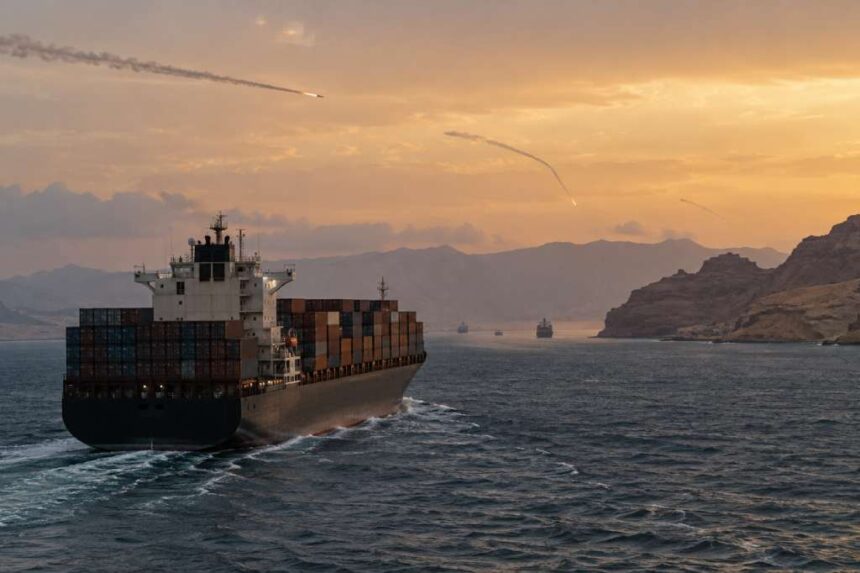
Beginning in late 2023, attacks against commercial ships generated a severe maritime security crisis. Major shipping companies, including Maersk, MSC, Hapag-Lloyd, and CMA CGM, suspended or reduced Red Sea transits and rerouted vessels around the Cape of Good Hope.
Economic Cost of Houthi Attacks on Global Shipping
1. Additional Distance and Transit Time
The most immediate impact involved route diversion around southern Africa.
A typical Asia-Europe voyage through the Suez Canal is significantly shorter than the alternative route around the Cape of Good Hope.
According to UNCTAD, World Bank, and maritime industry assessments:
- Additional sailing distance: approximately 3,500-4,500 nautical miles depending on route.
- Some vessel classes experienced increases approaching 6,000 nautical miles.
- Transit times increased by 10-15 days on average.
- Certain oil shipments experienced delays of nearly two weeks.
The U.S. Energy Information Administration estimated that some voyages from the Arabian Sea to Europe became approximately 15 days longer when diverted around Africa.
2. Increased Fuel Costs
A modern container vessel consumes between 100 and 250 tons of fuel per day.
An additional 10-15 sailing days can generate:
- Extra fuel costs ranging between USD 500,000 and USD 1 million per voyage, depending on vessel size and bunker fuel prices.
With hundreds of vessels diverted monthly, the aggregate impact reached billions of dollars.
3. Higher Insurance Premiums
Insurance costs increased dramatically.
Before the crisis:
- War-risk premiums averaged approximately 0.05%-0.1% of vessel value.
After intensified Houthi attacks:
- Premiums rose to 0.3%-1% of vessel value.
- Some high-risk voyages reportedly faced insurance costs exceeding USD 1 million per transit.
- For a USD 200 million vessel, a 1% premium translates to USD 2 million for a single voyage.
These costs were ultimately passed on to importers, exporters, and consumers.
4. Freight Rate Inflation
UNCTAD reported sharp increases in container freight rates during early 2024. According to maritime industry data:
- Asia-Europe container rates more than doubled in some segments.
- Certain routes recorded increases exceeding 100 percent.
The consequences extended beyond transportation markets into broader inflationary pressures affecting consumer products and industrial goods.
5. Suez Canal Revenue Losses
Egypt experienced severe economic consequences. Because vessels increasingly avoided the Red Sea:
- Suez Canal traffic declined dramatically.
- Container tonnage crossing the canal fell by approximately 82% during the initial phase of the crisis.
Independent estimates suggested Egypt suffered hundreds of millions of dollars in monthly revenue losses.
Estimated Aggregate Economic Impact
Although exact calculations vary, studies from international organizations and maritime analysts suggest that:
- Global trade disruptions generated costs measured in the tens of billions of dollars.
- Additional transport expenditures alone reached several billion dollars in 2024.
- Supply-chain inefficiencies created secondary economic effects substantially exceeding direct shipping costs.
The Red Sea crisis therefore became one of the most economically significant disruptions to maritime commerce since the COVID-19 pandemic.
Threats to Global Digital Infrastructure
A less examined consequence involves submarine communication cables. The Red Sea hosts numerous fiber-optic cables connecting Europe, Asia, and Africa. These systems carry substantial portions of global data traffic. The World Bank and other analysts have highlighted concerns that military activity, drifting anchors, vessel incidents, or intentional sabotage could damage critical communications infrastructure.
Such incidents could affect:
- Financial transactions;
- Cloud computing services;
- International telecommunications;
- Military communications.
The possibility that regional conflict could disrupt both physical trade and digital connectivity demonstrates the growing strategic relevance of the Red Sea.
The Houthis within Iran’s Axis of Resistance
The Gaza conflict accelerated the integration of the Houthis into Iran’s broader regional network. Alongside Hezbollah, Iraqi militias, and Palestinian armed groups, the Houthis increasingly participated in a coordinated strategic framework aimed at exerting pressure on Israel, the United States, and their regional partners. Houthi missile and drone launch toward Israel, coupled with attacks on commercial shipping, illustrated a broader strategy of multidimensional deterrence.
For Tehran, the Houthis provide:
- Geographic reach into the Red Sea;
- Pressure against Gulf monarchies;
- Influence over global maritime trade;
- A mechanism for escalating tensions without direct confrontation.
Conclusion
The evolution of the Houthis from a marginalized revivalist movement into a globally consequential proxy force represents one of the most significant geopolitical developments in the contemporary Middle East. Initially rooted in local grievances and sectarian revivalism, the movement capitalized on state weakness, regional rivalries, and external support to become a sophisticated military and political actor. Iranian assistance accelerated this transformation, enabling the Houthis to develop capabilities traditionally associated with state armed forces. Their actions since 2023 have demonstrated that non-state actors can influence strategic maritime chokepoints, disrupt global supply chains, raise transportation and insurance costs, threaten energy security, and potentially affect digital communications infrastructure. The resulting economic costs amount to billions of dollars annually and have reshaped global shipping patterns. As tensions between Iran, Israel, Saudi Arabia, and the United States continue, the Houthis are likely to remain a pivotal actor in regional security calculations. Their capacity to project force beyond Yemen’s borders ensures that developments involving Ansar Allah will continue to affect not only Middle Eastern geopolitics but also the wider international economic system.
References
- International Crisis Group, Yemen’s al-Houthis: From Insurgency to Proxy War, Middle East Report No. 154, 2016.
- BBC News, “Who are Yemen’s Houthis?”, February 2024.
- Carnegie Middle East Center, Iran’s Proxy Strategy in Yemen, 2021.
- Reuters, “Houthis Seize Yemen’s Capital Sana’a”, 21 September 2014.
- New York Times, “Saudi Oil Attack Was a Warning”, 16 September 2019.
- UNCTAD, Navigating Troubled Waters: Impact to Global Trade of Disruption of Shipping Routes in the Red Sea, Black Sea and Panama Canal, February 2024.
- World Bank, The Deepening Red Sea Shipping Crisis: Impacts and Outlook, February 2025.
- U.S. Energy Information Administration (EIA), Red Sea Disruptions Increase Oil Flows Around Cape of Good Hope, 11 June 2024.
- Lloyd’s List, Red Sea War Risk Rates Still Rising After Doubling in Past Week, 20 December 2023.
- BusinessDay, War Risk Premiums for Cargoes Surge Amid Red Sea Crisis, 31 January 2024.
- World Bank, The Deepening Red Sea Shipping Crisis: Impacts and Outlook, 2025.
- Brookings Institution, Iran’s Proxy Network and Global Security, 2024.
- Washington Post, “U.S. Navy Confronts Houthi Attacks in the Red Sea”, January 2024.
- UN OCHA, Yemen Humanitarian Overview, 2023.
- Maersk, The Ongoing Ripple Effects of Red Sea Shipping Disruptions, July 2024.
- U.S. Energy Information Administration, Fewer Tankers Transit the Red Sea in 2024, October 2024.