

Introductin
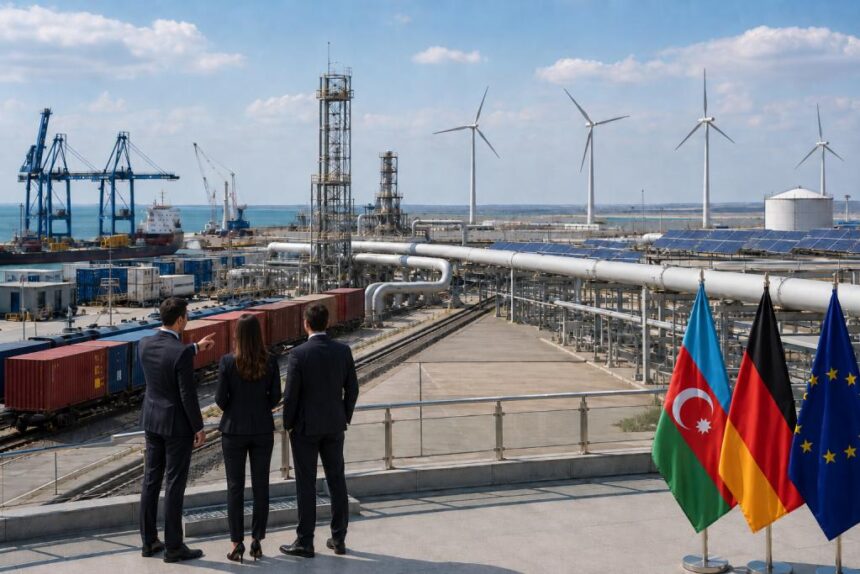
In recent years, geopolitical shifts have fundamentally reshaped the economic relations between the European Union (EU) and Azerbaijan. Once viewed primarily as a major energy exporter, Azerbaijan is increasingly developing into a strategic economic and logistics partner for Europe. Against the backdrop of changes in Europe’s energy supply architecture, cooperation between the EU and Azerbaijan has gained substantial importance.
- Introductin
- The European Union as Azerbaijan’s Principal Economic Partner
- Germany and Azerbaijan: A Historically Grown Partnership
- Germany’s Economic Significance for Azerbaijan
- Why Azerbaijan is Becoming Strategically More Important for Germany
- Sectors with Strong Growth Potential
- Mechanical and Plant Engineering
- Renewable Energy
- Infrastructure and Transport
- Chemical Industry
- Agriculture and Food Industry
- Healthcare Sector
- German Companies with Strong Potential
- Policy Measures to Further Develop Economic Relations
- 1. Conclusion of a Modern EU–Azerbaijan Agreement
- 2. Strengthening Investment Promotion
- 3. Intensifying Business Networks
- 4. Joint Innovation Centres
- 5. Vocational Training Based on the German Model
- 6. Expanding Transport Infrastructure
- Key Challenges
- Outlook
Within this relationship, Germany occupies a special position. As Europe’s largest economy, a leading technology and industrial hub, and one of the EU’s most important investors, Germany is exceptionally well placed to elevate economic cooperation with Azerbaijan to a new level.
The European Union as Azerbaijan’s Principal Economic Partner
The EU is by far Azerbaijan’s most significant trading and investment partner. Around 40 percent of the country’s total foreign trade is conducted with EU member states, while Europe represents the largest sales market for Azerbaijani exports and the most important source of foreign investment. The partnership rests on the EU–Azerbaijan Partnership and Cooperation Agreement, which has been in force since 1999, and negotiations continue on a modernised, comprehensive framework agreement designed to update and deepen this cooperation.
Hydrocarbons have traditionally dominated bilateral trade flows: Azerbaijan exports crude oil and natural gas, while the EU supplies machinery, vehicles, chemical products, industrial equipment and high-quality capital goods. At the same time, the EU aims to broaden the economic relationship and actively support the diversification of Azerbaijan’s economy beyond the oil and gas sector.
Germany and Azerbaijan: A Historically Grown Partnership
Relations between Germany and Azerbaijan go back much further than the diplomatic contacts established following Azerbaijan’s independence in 1991. In the 19th century, settlers from Württemberg founded several German colonies in what is now Azerbaijan, including Helenendorf (today Göygöl) and Annenfeld (today Şəmkir). These communities shaped agriculture, viticulture, crafts and early industrial development in the region for decades, leaving a tangible historical and cultural legacy still visible in buildings, churches and other institutions.
This shared history has fostered a particular sense of cultural proximity, which can serve as an important basis of trust in international economic relations. It is complemented today by numerous university partnerships, scientific cooperation projects and the strong presence of German institutions in Baku, such as the German Chamber of Commerce Abroad (AHK), the Goethe Centre and various research collaborations.
Germany’s Economic Significance for Azerbaijan
Germany is Azerbaijan’s most important economic partner in the South Caucasus. Bilateral trade amounts to roughly €1.7 billion, with Germany importing mainly crude oil and, increasingly, other energy products, while exporting machinery, vehicle technology, industrial equipment, steel products and high-value capital goods to Azerbaijan.
The German Chamber of Commerce Abroad in Baku plays a particularly noteworthy role. It is the only AHK in the entire South Caucasus region and has, for many years, served as a central platform for investment, business partnerships and corporate engagement between the two countries.
Why Azerbaijan is Becoming Strategically More Important for Germany
The strategic relevance of Azerbaijan for Germany now extends well beyond the energy sector.
Energy Supply
Following the sharp reduction in imports of Russian energy, Azerbaijan has become one of Europe’s most important alternative suppliers. Through the Southern Gas Corridor, Caspian gas reaches European markets, contributing to the diversification and security of supply. Cooperation is expanding into new areas such as hydrogen, offshore wind in the Caspian Sea and electricity from renewable sources, making the energy partnership an integral element of Europe’s broader diversification strategy.
Middle Corridor as a Trade Route
Azerbaijan is increasingly emerging as a central logistics hub between Europe and Central Asia. The so‑called Middle Corridor links China, Central Asia, the Caspian Sea, the South Caucasus and Europe, positioning Azerbaijan as a key node in Eurasian transport chains. The Port of Alat and modern rail and road connections create significant opportunities for German logistics, infrastructure and industrial companies.
Economic Diversification
The Azerbaijani government is investing heavily in the development of non‑oil sectors. Priority areas include:
– Digitalisation
– Industry 4.0
– Smart cities
– Agriculture
– Tourism
– Healthcare
– Water management
– Renewable energy
– Chemical industry
– Food processing
This broad‑based diversification agenda opens up substantial market potential for German companies with relevant technologies and expertise.
Sectors with Strong Growth Potential
Mechanical and Plant Engineering
German mechanical and plant engineering enjoys an excellent reputation in Azerbaijan for quality and technological sophistication. Companies such as Siemens, Bosch, KSB, GEA, Festo and Trumpf offer solutions that can be directly applied to expanding industrial production, improving water management and modernising energy infrastructure.
Renewable Energy
Azerbaijan has considerable potential for offshore wind energy in the Caspian Sea and for solar power generation onshore. German firms can bring to bear their experience in:
- Wind energy technologies
- Solar equipment and systems
- Battery storage solutions
- Hydrogen technologies
- Smart grids and intelligent power management
These capabilities are highly relevant for the country’s planned green transition.
Infrastructure and Transport
The development of the Middle Corridor creates opportunities across:
- Rail transport
- Port and terminal logistics
- Digitalisation of supply chains
- Customs systems and border management
- Freight transport solutions
- Intelligent transport systems
German expertise in rail engineering, logistics, planning and digital transport solutions positions German companies well to participate in these projects.
Chemical Industry
German chemical companies can contribute both to modernising the petrochemical sector and to developing specialty chemicals, environmental technologies and recycling solutions. This supports Azerbaijan’s efforts to move up the value chain and reduce its dependence on raw commodity exports.
Agriculture and Food Industry
Azerbaijan is undertaking extensive modernisation of its agricultural sector. This opens up demand for:
- Agricultural machinery
- Irrigation and water‑efficient technologies
- High‑quality seed and inputs
- Food processing equipment
- Cold chain solutions
- Packaging technologies
German suppliers can support productivity gains from farm to fork.
Healthcare Sector
The expansion of modern clinics and healthcare infrastructure is increasing demand for:
- Medical technology and diagnostic equipment
- Hospital furnishings and systems
- Digital health applications
- Laboratory technology
- Pharmaceutical products
German companies in medtech and pharma are well placed to meet these needs.
German Companies with Strong Potential
A wide range of German enterprises could benefit from a deeper opening of the Azerbaijani market and closer bilateral cooperation. These include, among others:
- Siemens AG
- Siemens Energy
- Bosch
- SAP
- Deutsche Bahn Engineering & Consulting
- DHL Group
- Festo
- Trumpf
- KSB
- GEA Group
- Bayer
- BASF
- Covestro
- Heidelberg Materials
- Knauf
- CLAAS
- Herrenknecht
In addition, many small and medium‑sized enterprises from Germany’s mechanical and plant engineering sectors could tap into new opportunities through targeted engagement and suitable financing and risk‑mitigation instruments.
Policy Measures to Further Develop Economic Relations
To significantly expand economic ties, policymakers and the private sector in both countries, together with EU institutions, should pursue a set of coordinated initiatives.
1. Conclusion of a Modern EU–Azerbaijan Agreement
A modernised partnership and cooperation agreement between the EU and Azerbaijan would substantially improve investment protection, legal certainty and market access. It could provide a clearer framework for trade, services and digital cooperation, thereby encouraging long‑term corporate engagement.
2. Strengthening Investment Promotion
Germany, working closely with the EU, should:
– Broaden export credit guarantees
– Facilitate investment insurance and risk cover
– Expand financing programmes for cross‑border projects
– Intensify KfW and European Investment Bank (EIB) activities
These measures would help reduce risk for investors and support larger, capital‑intensive projects in infrastructure and industry.
3. Intensifying Business Networks
The AHK in Baku should continue to strengthen its role as a central platform for bilateral business cooperation. Regular economic forums, innovation conferences and trade missions could deepen direct exchange between companies, foster joint ventures and help identify concrete projects on the ground.
4. Joint Innovation Centres
German–Azerbaijani innovation centres could link start‑ups, research institutions and industrial companies more closely. Thematic priorities might include:
- Digitalisation
- Artificial intelligence
- Hydrogen and Green Tech
- Smart manufacturing and Industry 4.0
Such centres would support technology transfer, promote new business models and help anchor high‑value activities in Azerbaijan.
5. Vocational Training Based on the German Model
Germany’s dual vocational training system is internationally recognised. Introducing or expanding dual training approaches in Azerbaijan could simultaneously:
- Secure a skilled workforce
- Support German companies operating locally
- Strengthen Azerbaijan’s competitiveness in industry and services
Close cooperation between chambers, vocational schools and companies would be crucial for success.
6. Expanding Transport Infrastructure
Germany could assume technological leadership roles in developing rail corridors, logistics hubs and intelligent customs systems. This would not only support Azerbaijan’s ambitions as a transport and logistics hub, but also improve connectivity for European trade with Central Asia and beyond.
Key Challenges
Despite promising opportunities, several challenges remain:
- Ongoing, but not yet concluded, negotiations on Azerbaijan’s accession to the World Trade Organization (WTO)
- Need for further reforms in investment protection, legal certainty and regulatory transparency
- Geopolitical tensions in the South Caucasus and their potential impact on stability
- The need to balance energy security with the EU’s climate and decarbonisation objectives
Precisely in light of these factors, a long‑term economic partnership based on mutual trust and clear rules gains in importance.
Outlook
Germany and Azerbaijan are linked by much more than energy trade alone. Shared historical roots, long‑standing economic cooperation and complementary economic structures create excellent conditions for a deepened partnership. While Germany contributes technology, innovation, industrial expertise and training excellence, Azerbaijan offers strategic geographical advantages between Europe and Asia, substantial energy and raw material resources, and ambitious programmes for economic diversification.
The coming years offer an opportunity to develop relations from a primarily energy‑focused cooperation into a comprehensive partnership in innovation, industry and investment. If this transition succeeds, Azerbaijan could become one of Europe’s most important economic bridgeheads in the South Caucasus and Central Asia, with Germany acting as a central strategic partner.