

Abstract
geopolitics. Rather than signaling a diplomatic breakthrough, the meeting with President XiJinping underscores a deeper structural transformation in the international system—onecharacterized by strategic rivalry, economic interdependence, and persistent globaluncertainty.
- Abstract
- Introduction: Diplomacy Without Illusions
- 1. Historical Foundations: From Strategic Opening to Strategic Rivalry
- 2. The Trump–Xi Summit: Stabilization Without Resolution
- 3. Energy Geopolitics: China, Iran, and Strategic Interdependence
- 4. Pakistan’s Role: Continuity, Constraint, and Strategic Mediation
- 5. Taiwan and the Strategic Centrality of Technology
- 6. Strategic Bargaining and Competitive Interdependence
- 7. Implications for the Global Order
- Conclusion: Managing Rivalry in an Interdependent World
- Footnotes
This article places the visit within a broader historical and geopolitical framework. It drawsparallels with the Nixon-era rapprochement, while emphasizing the fundamental differencesbetween Cold War strategic alignment and today’s competitive interdependence. Byintegrating three interconnected dimensions—China’s energy relationship with Iran,Pakistan’s re-emergence as a diplomatic intermediary, and Taiwan’s centrality insemiconductor supply chains—the analysis demonstrates how regional dynamics arereshaping global power politics.
The article argues that contemporary diplomacy is no longer centered on resolving conflictsor building alliances, but on managing tensions and avoiding escalation in a fragmented andinterconnected world.
Introduction: Diplomacy Without Illusions
Trump’s visit to Beijing in May 2026 did not carry the symbolic weight of earlier momentsin U.S.–China relations. There were no expectations of a breakthrough comparable toNixon’s historic opening. Instead, the visit reflected a more restrained and pragmaticreality: Washington and Beijing are locked in a relationship defined simultaneously byrivalry and necessity.
Over the past decade, bilateral tensions have intensified across multiple fronts—tradedisputes, technological competition, Taiwan, and diverging geopolitical agendas. Yet,despite these tensions, the two countries remain deeply interconnected. Their economicsystems are intertwined, their supply chains interdependent, and their strategic decisionscarry global consequences.
In this context, diplomacy is no longer about transformation. It is aboutcontrol—containing competition, preventing crises, and managing risks. Trump’s 2026visit is best understood through this lens.
1. Historical Foundations: From Strategic Opening to Strategic Rivalry
The natural historical reference point for Trump’s visit is the Nixon administration’srapprochement with China in the early 1970s. Nixon’s 1972 meeting with Zhou Enlaimarked the end of decades of hostility and fundamentally altered the geopoliticallandscape of the Cold War.1
This shift was preceded by a decisive institutional development. In 1971, the UnitedNations recognized the People’s Republic of China as the legitimate representative of China,replacing Taiwan in the Security Council.2 The decision was formalized through GeneralAssembly Resolution 2758, introduced by Albania and supported by a coalition of statesincluding Algeria, Romania, and Pakistan. Rather than a purely procedural change, theresolution reflected broader geopolitical calculations and acknowledged the growingpolitical and strategic weight of Beijing within the international system.
The success of the U.S.–China opening rested on a convergence of strategic interests,particularly the shared objective of counterbalancing the Soviet Union. In that sense,diplomacy served as a mechanism for realignment.
Today, no such convergence exists. The United States and China increasingly view oneanother not as potential partners, but as systemic competitors. While diplomacy remainsessential, its role has changed. It no longer seeks to restructure the global order; instead, itaims to stabilize it.
2. The Trump–Xi Summit: Stabilization Without Resolution
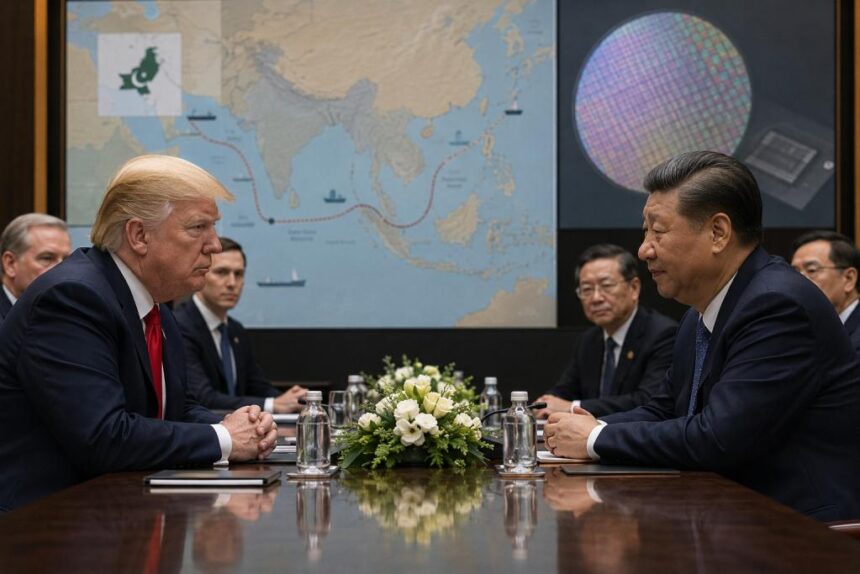
The 2026 Trump–Xi meeting took place against a backdrop of accumulated tensions. Tradedisputes—initiated during Trump’s first administration and intensified after his return tooffice—had expanded into broader competition over technology, supply chains, and globalinfluence.3
Although Trump announced progress on trade, including commitments by China topurchase U.S. goods, analysts widely viewed these outcomes as limited and largelysymbolic. 4 More important than the formal results were the strategic messages conveyedduring the summit.
Taiwan emerged as the most sensitive issue. Xi Jinping warned that mishandling thequestion could lead to “clashes and even conflict,” underscoring its centrality in bilateralrelations. 5
At the same time, both sides addressed global security concerns, particularly the Iranconflict and disruptions in the Strait of Hormuz—one of the world’s most critical energycorridors. 6 These discussions highlighted the interconnected nature of regional crises andglobal economic stability.
Ultimately, the summit demonstrated a shared, if cautious, commitment to avoidingescalation. Both sides signaled an understanding that competition must remain controlled. 7
3. Energy Geopolitics: China, Iran, and Strategic Interdependence
China’s relationship with Iran constitutes a critical element of the broader strategicenvironment. Despite U.S. sanctions, China remains the largest importer of Iranian oil. In2025, imports averaged approximately 900,000 barrels per day, with some estimatesranging between 1.3 and 1.8 million barrels depending on market conditions. 8
Iranian crude is typically sold at a discount of $8–10 per barrel below global benchmarks,making it particularly attractive for Chinese refiners. 9 In total, Iran exportedapproximately 520 million barrels of oil to China in 2025, underscoring the scale of thisrelationship. 10
This energy partnership carries significant geopolitical implications. It strengthens China’sresilience against Western sanctions, creates indirect alignment between Beijing andTehran, and ties China’s economic stability to developments in the Middle East.
For the United States, this dynamic complicates efforts to isolate Iran while reinforcing theglobal dimension of regional conflicts. The prominence of the Iran issue in the Trump–Xidiscussions reflects this reality. 11
4. Pakistan’s Role: Continuity, Constraint, and Strategic Mediation
Pakistan’s re-emergence as a mediator in the 2026 U.S.–Iran crisis highlights a broader shift in theinternational system, where middle powers increasingly act as connectors in a fragmentedgeopolitical landscape. Islamabad facilitated dialogue, hosted negotiations, and contributed toceasefire efforts, positioning itself as a critical intermediary at a moment of regional volatility. 12
This diplomatic role is rooted in Pakistan’s unique geopolitical positioning. Its close strategicpartnership with China, functional—if at times strained—relations with the United States, andlongstanding geographic and political links to Iran enable it to operate across otherwise competing
spheres.13 In this sense, Pakistan occupies a rare space of overlapping influence within anincreasingly polarized international environment.
The current moment also carries a notable historical parallel. In 1971, Pakistan facilitated HenryKissinger’s secret diplomacy with China, paving the way for Nixon’s landmark visit and thenormalization of U.S.–China relations.14 While the strategic circumstances have changed, theunderlying function remains similar: Pakistan acting as a bridge between major powers at momentsof geopolitical transition.
However, Pakistan’s contemporary role is shaped not only by opportunity, but by necessity. Regionalinstability has had direct economic and security consequences. Disruptions in Gulf shipping havesharply increased energy costs, with Pakistan importing approximately 85–90% of its crude oil andnearly 99% of its liquefied gas from external suppliers. The resulting price shocks have significantlyraised the country’s fuel import bill and forced domestic price increases exceeding 50%, placingadditional strain on an already fragile economy.
At the same time, internal security concerns—particularly in Balochistan—have heightenedIslamabad’s sensitivity to regional spillover. Escalation in the Iran conflict risks further destabilizingborder regions already affected by insurgency dynamics, reinforcing the imperative for de-escalation.
Economic considerations have also reinforced Pakistan’s engagement. In July 2026, Islamabadconcluded an agreement with the United States aimed at developing its largely untapped domesticoil reserves, reflecting an attempt to diversify energy sources and reduce vulnerability to externalshocks. As noted by Mushahid Hussain Syed, a former chairman of Pakistan’s Senate DefenseCommittee, this alignment also reflects an ability within Islamabad to read and respond pragmaticallyto shifting U.S. policy signals.
Pakistan’s relationship with Iran further underscores the complexity of its mediating role. While Iranwas the first country to recognize Pakistan’s independence in 1947, bilateral relations havehistorically fluctuated. Periodic tensions—often linked to disputes over Balochistan and Pakistan’sties with Iran’s regional rivals—have alternated with phases of cooperation. As recently as January2024, relations appeared to be deteriorating; however, tensions soon receded, and both countriesmoved to restore diplomatic engagement, expand security cooperation, and formalize reconciliationthrough high-level exchanges.
Taken together, these dynamics highlight that Pakistan’s role in 2026 cannot be understood solely asdiplomatic positioning. It is the product of overlapping strategic imperatives—economic vulnerability,internal security concerns, and geopolitical opportunity. More broadly, it illustrates how middlepowers are increasingly functioning as systemic stabilizers, shaping outcomes not throughdominance, but through connectivity and mediation.
5. Taiwan and the Strategic Centrality of Technology
Taiwan represents the most consequential flashpoint in U.S.–China relations—not onlypolitically, but technologically. The island produces over 60% of the world’s advancedsemiconductors, making it indispensable to industries ranging from artificial intelligenceto defense systems.15
This “silicon shield” transforms Taiwan into a global strategic asset. The United Statesdepends on Taiwanese chips to sustain its technological leadership, while China seeks toreduce its dependence and secure supply chains.
Any disruption to Taiwan’s semiconductor industry would have far-reaching globalconsequences, affecting production, trade, and financial stability. This elevates Taiwan froma regional dispute to a systemic risk.
The prominence of the Taiwan issue in the Trump–Xi meeting reflects its central role inshaping the future balance of power.
6. Strategic Bargaining and Competitive Interdependence
The Trump visit underscores a broader shift in U.S.–China relations—from cooperation tostrategic bargaining within a framework of competitive interdependence.
The United States seeks fairer trade terms, greater control over technology transfer,stability in supply chains, and Chinese cooperation on global crises. China, in turn, seekstariff reductions, continued market access, recognition as a global power, and restraintfrom Washington on Taiwan and regional security issues.
Neither side is willing—or able—to fully disengage. Economic interdependence remainstoo deep. At the same time, strategic competition continues to intensify.
This dynamic produces a form of negotiation that is ongoing, incremental, and ofteninconclusive. Trump’s visit reflects this reality: a process of managing competition ratherthan resolving it.
7. Implications for the Global Order
The implications of the Trump–Xi summit extend beyond bilateral relations.
First, it confirms that stabilization without resolution has become the defining feature ofgreat-power diplomacy.
Second, it highlights the emergence of multipolar diplomacy, where middle powers suchas Pakistan play increasingly important roles.
Third, it reinforces the energy–security nexus, demonstrating how resource flows shapegeopolitical dynamics.
Fourth, it signals the acceleration of technological competition, particularly insemiconductors and artificial intelligence.
Finally, it underscores the enduring importance of Taiwan as a strategic flashpoint, withimplications for both regional and global stability.
Conclusion: Managing Rivalry in an Interdependent World
Trump’s 2026 visit to China captures a fundamental shift in the nature of global politics.Unlike the Nixon era, where diplomacy facilitated strategic alignment, today’s diplomacyoperates under conditions of structural rivalry.
The relationship between the United States and China is unlikely to return to cooperation-driven engagement. Instead, it will remain defined by competition tempered by necessity.
In this environment, the primary objective of diplomacy is not transformation, butrestraint. Success is measured not by agreements reached, but by crises avoided.
The broader conclusion is clear: the emerging global order will not be shaped by decisiveturning points alone, but by continuous efforts to manage tensions across interconnecteddomains. Trump’s visit is one such effort—limited in outcome, but significant in what itreveals about the future of international relations.
Footnotes
- 1. Bill of Rights Institute, Richard Nixon Opens Diplomatic Relations with China.
- 2. Ibid.
- 3. The Hindu, “US–China and the Search for Stability.”
- 4. Fox News; CBS News, coverage of Trump’s 2026 China visit.
- 5. NBC News, Trump–Xi summit reporting.
- 6. CBS News, “Trump wraps up visit with Xi in China.”
- 7. Times Now News, “Key outcomes of the Trump–Xi summit.”
- 8. ChinaData; Beijing Post; Modern Diplomacy reports on China–Iran oil imports.
- 9. Modern Diplomacy, “China’s dependence on Iranian oil.”
- 10. Politico, “Iran oil exports to China.”
- 11. NBC News, op. cit.
- 12. Council on Foreign Relations, analysis of Pakistan’s mediation role.
- 13. Global Affairs, commentary on Pakistan’s diplomatic positioning.
- 14. The Conversation, “Pakistan’s role in US–China rapprochement.”
- 15. Hague Centre for Strategic Studies-HCSS, “Taiwan’s Semiconductor Role.”